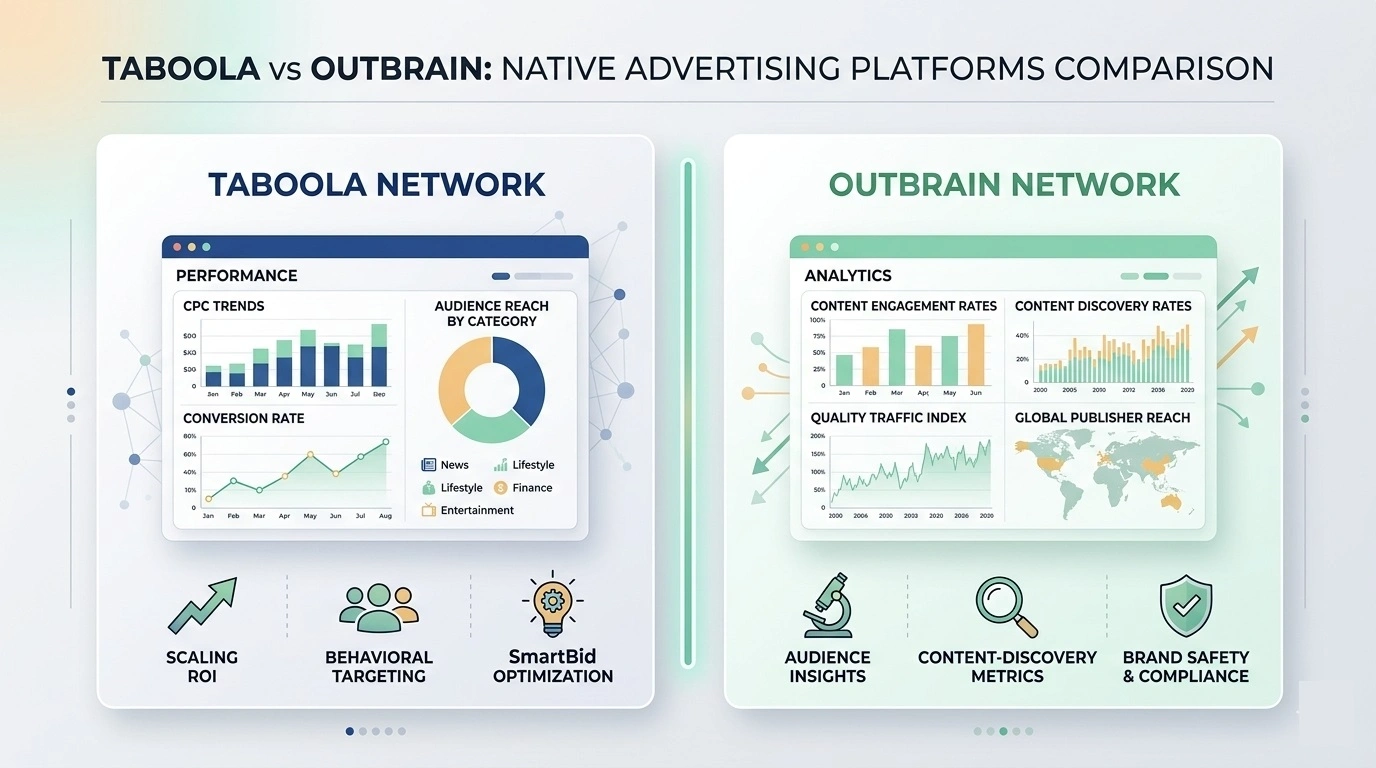
Taboola vs Outbrain: Key Differences for Advertisers and Publishers in 2026
Choosing between Taboola and Outbrain depends on what you need from a native advertising platform. Advertisers compare campaign setup, optimization options, publisher inventory, tracking, and cost per result. Publishers have a different checklist: eligibility, audience fit, monetization terms, reporting, and the effect of recommendations on the reader experience. There is no universal winner; compare the options against your own goals and account-level data.
A shortcut such as “Taboola for volume, Outbrain for quality” can be useful as a hypothesis, but it is not a dependable rule. Inventory, campaign objectives, bidding settings, geography, creative, and conversion tracking all affect results. Treat platform comparisons as a starting point, then validate them with current documentation and a controlled test.
This guide separates practical decision factors from claims that require account data or current platform documentation.
For advertisers using an advertorial, the important question is not simply which network gets more clicks. It is whether traffic, message, landing-page experience, offer, and measurement work together to produce the outcome you are paying for.
Use the comparison below to decide what to investigate first—not as a promise that either platform will deliver a particular result.
Explore 600+ ready-to-customize HTML advertorial templates across multiple niches and funnel structures. Review the available options and adapt a suitable starting point to your offer.
Taboola vs Outbrain: Quick Comparison
| Factor | Taboola | Outbrain | What Actually Matters |
|---|---|---|---|
| Learning Speed | Depends on budget, targeting, and available conversion data | Depends on campaign setup and available inventory | How quickly you can iterate |
| Traffic Quality Floor | Placement and audience performance vary | Placement and audience performance vary | Your placement management matters more than platform choice |
| Algorithm Focus | Depends on selected campaign objective and settings | Depends on selected campaign objective and settings | Compare results using the same conversion definitions |
| Approval Speed | Review timing and decisions can vary | Review timing and decisions can vary | Check current review requirements before launch |
| Scaling Behavior | Performance depends on budget changes and campaign signals | Performance depends on budget changes and campaign signals | Your nerves matter here |
| Best For | Choose based on objective, inventory, and measured results | Choose based on objective, inventory, and measured results | Your funnel determines this |
| Worst For | Campaigns that do not meet current policies | Campaigns that do not meet current budget or tracking needs | Know your constraints |
This table tells you the "what." The rest of this article tells you the "why" and the "so what."
What Is the Difference Between Taboola and Outbrain?
The practical differences are found in available inventory, campaign objectives, bidding and optimization controls, reporting, publisher mix, and requirements for advertisers and publishers. Features and product names can change, so confirm them in each platform’s current documentation before making a budget decision.
Do not assume that every Taboola campaign is optimized only for clicks. The available optimization strategy depends on the campaign setup and the products or objectives enabled for the account. Check the settings available to you and confirm that the selected objective matches the business outcome you measure.
Likewise, do not assume that every Outbrain campaign will automatically optimize for conversions or produce more consistent results. Performance depends on the selected bidding strategy, conversion events sent back to the platform, campaign maturity, and available traffic.
Here's the implication nobody talks about: if your advertorial is weak, Taboola will waste your money faster. The algorithm will find clicks, but those clicks won't convert, and you'll burn budget quickly. Outbrain might waste your money slower because it's trying to optimize for conversions — but if your funnel doesn't convert, it will just deliver fewer clicks at the same cost per conversion.
The platform doesn't fix a broken funnel. It just changes how quickly you discover it's broken.
Taboola vs Outbrain: Publisher Reach & Traffic Quality
The Publisher Network Reality
Traffic quality should be assessed at placement and campaign level, not inferred from a platform-wide label. Compare qualified visits, leads, sales, or another agreed conversion event using consistent tracking.
Both networks connect advertisers with publisher inventory, but the placements available to a campaign depend on geography, vertical, account access, targeting, and network supply. Avoid assuming that one network always offers higher-quality traffic. Review placement-level results and the controls available in your account.
The difference is in how each platform manages that variance.
For Taboola, inspect the campaign objective, available placement reporting, exclusions, and optimization controls in your account. Evaluate placements against meaningful downstream metrics—not CTR alone—before deciding which inventory to keep or exclude.
For Outbrain, check the targeting, bidding, reporting, and inventory controls available for your campaign. Do not infer traffic quality from a network’s positioning or publisher list alone; evaluate qualified leads, sales, or another agreed conversion event.
What This Means for Your Campaign
If you're running a direct response offer with a strong advertorial, Taboola's volume advantage helps you find converters faster — you'll test more placements, gather more data, and scale winners quickly.
If you're running a brand campaign or lead generation where context matters, Outbrain's curation helps protect your brand from appearing next to questionable content.
But here's the uncomfortable truth: most advertisers blame traffic quality for what is actually an advertorial problem.
They run a weak advertorial, get poor conversion rates, and conclude the traffic is bad. Then they switch platforms, run the same weak advertorial, get the same poor results, and blame the platform again.
The traffic quality question is real, but it's secondary to the funnel quality question.
Taboola vs Outbrain: CPC & Advertising Costs
There is no single CPC that reliably represents either platform across verticals, geographies, devices, and campaign objectives. Treat published averages as directional only unless the source explains the date, market, sample, and methodology. Your own account data is the best basis for budgeting.
What I can tell you is how the cost dynamics work on each platform.
Taboola's Cost Dynamics
Actual costs on Taboola depend on the campaign, bid strategy, market, audience, creative, and competition. Monitor CPC alongside conversion rate and CPA; a lower click cost is not necessarily a lower customer-acquisition cost.
Taboola's algorithm optimizes toward engagement, which means it will find placements where people click — but those placements might not be where people convert. This creates a dynamic where your CPC might look great while your CPA is terrible.
The fix: You need to actively manage placements, build block lists, and use conversion tracking religiously. Don't let Taboola's algorithm optimize for clicks when you need it to optimize for conversions.
Outbrain's Cost Dynamics
Actual costs on Outbrain also depend on campaign settings, market, competition, and optimization signals. Do not assume its CPC is always higher or its performance more predictable without comparing like-for-like campaigns.
Outbrain's Smartbid algorithm optimizes toward conversions, which means it will spend more per click on placements that actually convert. Your CPC might look higher, but your CPA could be lower because you're not wasting money on clicks that never become customers.
The fix: Trust the algorithm more on Outbrain. Give it clear conversion signals and let it optimize. Your job is to ensure your funnel converts, not to micromanage placements.
The Real Cost Question
The question isn't "which platform is cheaper?" It's "which platform gives you better ROAS for your specific funnel?"
There is no universal ROAS winner. To compare fairly, run tests with comparable offers, landing pages, conversion definitions, attribution windows, and a budget appropriate to each platform. Record spend, revenue, CPA, and ROAS, then account for differences in learning time and traffic mix.
The variable that determines which platform wins isn't the platform — it's your advertorial. A strong advertorial can succeed on either platform. A weak one will fail on both.
Targeting & Optimization
Both platforms offer similar targeting options: contextual, interest-based, lookalike, retargeting, geographic, device. The tools are comparable.
What differs is how the optimization algorithms use that targeting data.
Taboola's Optimization Philosophy
Taboola's algorithm is aggressive. It explores widely, tests many combinations, and responds quickly to performance signals. This is great when you're in the testing phase and need rapid feedback. It's less great when you've found a winning combination and want stability — the algorithm might keep exploring and find placements that erode your performance.
Performance can fluctuate on either platform as auctions, competition, placements, budgets, and conversion signals change. Review trends over a meaningful period rather than reacting to isolated daily swings.
Outbrain's Optimization Philosophy
Outbrain's algorithm is conservative. It explores more carefully, tests fewer combinations, and responds more slowly to performance signals. This is frustrating when you need rapid testing, but it's valuable when you've found a winner and want to scale it predictably.
Do not assume that Outbrain performance will be more stable. Assess volatility using your own campaign history and compare similar time periods.
The Optimization Insight Most People Miss
Your targeting options matter less than your creative testing strategy.
I've spent hours setting up sophisticated targeting on both platforms, only to discover that the biggest performance differences came from testing different advertorial angles, not different targeting parameters.
The targeting tools on both platforms are good enough. The real optimization happens in your creative: your headlines, your images, your advertorial copy, your offer presentation.
Allocate testing effort according to the bottleneck shown by your data. If CTR is weak, investigate creative and placement context; if clicks arrive but conversions do not, inspect message match, page experience, offer, and tracking before changing targeting.
Ad Formats & Creative Testing
Both platforms support standard native ads, video, carousels, and e-commerce formats. The formats are similar. The creative strategy is where the difference lies.
The Native Ad Creative Reality
Native ads live or die by their headlines. A great headline gets clicks regardless of platform. A weak headline gets ignored on both.
But here's the nuance: the types of headlines that work on each platform differ.
Do not assume that one headline style is inherently better on Taboola. Test truthful, specific variations and judge them on qualified visits and downstream outcomes as well as CTR.
Do not assume that one headline style is inherently better on Outbrain either. Test informative and benefit-led variants against the same conversion goal, while ensuring the landing page delivers what the headline promises.
This doesn't mean you need completely different creative for each platform. It means you need to test platform-specific variations.
The Creative Testing Framework I Use
When I launch a new campaign, I test multiple creative angles simultaneously:
- The Curiosity Angle: "What the Latest Research Says About [Topic]"
- The Authority Angle: "New Study Reveals Surprising Truth About [Topic]"
- The Story Angle: "How One [Person] Transformed Their [Result]"
- The Fear Angle: "A Common [Topic] Mistake—and How to Check for It"
- The Benefit Angle: "The Simple Method to [Desired Outcome]"
These are hypotheses to test, not established platform-wide rules. Avoid fear-based or authority-led claims unless they are truthful, substantiated, and permitted by the relevant platform policies.
But the advertorial is what determines conversion, not the headline. A clickbait headline might get traffic, but if the advertorial doesn't deliver on the headline's promise, the visitor bounces and the click is wasted.
Approval & Compliance
Both platforms have compliance requirements, but their enforcement differs significantly.
Taboola's Approval Process
Review timelines and enforcement can vary by campaign and policy category. Check Taboola’s current advertising policies and approval guidance before launch. This makes it easier to test bold angles and competitive offers. But leniency comes with risk: accounts can be suspended for policy violations that weren't caught during initial review.
An initial approval should not be treated as a guarantee of ongoing compliance. Review current policies before launch and whenever you materially change the creative, landing page, or offer.
Outbrain's Approval Process
Review timelines and policy decisions can vary by campaign and policy category. Check Outbrain’s current advertising policies and approval guidance before launch. This slows down testing but provides more protection. Ads that might slip through Taboola's review often get flagged on Outbrain.
Neither platform’s review process guarantees that a campaign will remain approved. Build policy review into the workflow and keep claims and landing-page content substantiated.
The Compliance Insight
Compliance isn't a barrier — it's a competitive advantage.
When you create advertorials that comply with platform policies while still converting, you have a moat. Other advertisers will get suspended, struggle with approvals, and quit. You'll keep running.
Investing in compliance-friendly creatives that still convert is one of the smartest moves you can make in native advertising.
Which Is Better for Advertorials?
This is the question that matters most, and most comparison articles barely touch it.
The Advertorial Funnel
Before comparing platforms for advertorials, let's clarify the funnel:
Native Ad → Click → Advertorial → Offer → Conversion
Each element has a specific job:
- Native Ad: Capture attention, generate the click
- Advertorial: Qualify the reader, build desire, pre-sell the offer
- Offer: The product, service, or lead magnet
- Conversion: The action you want
The platform determines who clicks and in what context. The advertorial determines what they do after they arrive.
Platform Considerations for Advertorials
Taboola works well for advertorials when:
- You're testing multiple angles aggressively
- You need volume to gather conversion data quickly
- Your offer has broad appeal
- You're running direct response campaigns
Outbrain works well for advertorials when:
- Your offer requires trust and credibility
- Your advertorial takes an editorial approach
- You're targeting a more educated audience
- You're building a long-term brand
The Critical Insight
The platform matters. But the advertorial determines what happens after the click.
A clear, relevant advertorial can help visitors understand an offer before they reach the conversion step, but the size of any improvement depends on the audience, offer, page, and baseline. Measure the effect with a controlled test rather than assuming a specific lift.
A fair comparison changes as few variables as possible. Keep the offer, page, conversion event, and attribution settings consistent, then compare each platform using enough data to make a useful decision.
A stronger advertorial may improve the post-click experience, but profitability still depends on the offer economics, traffic costs, conversion rate, and tracking quality.
This is why the most successful native advertisers obsess over advertorial quality as much as platform selection. They understand that platform choice gets you traffic, but advertorial quality gets you conversions.
Taboola vs Outbrain for Affiliates
Affiliate marketers face unique challenges in native advertising. They're promoting offers they don't control, competing with other affiliates running similar campaigns, and often working with thin margins.
What Affiliates Need
Speed: When a new offer drops, early movers capture the most profit before saturation.
Volume: Testing multiple offers and angles requires significant traffic.
Cost control: Affiliate margins demand careful CPC management.
Flexibility: Some affiliate offers push compliance boundaries.
Platform Assessment for Affiliates
Taboola's advantages: Lower minimum budgets make testing accessible. Higher volume means faster data. More lenient approvals let you test aggressive angles. Better for competitive niches.
Outbrain's advantages: Higher quality traffic can mean better conversion rates. Premium placements build trust. More stable performance. Better for offers requiring credibility.
The affiliate reality: Some affiliates test one network first and expand later; others use both. Choose based on account eligibility, offer restrictions, tracking quality, economics, and observed results—not a universal platform formula.
But here's what separates winners from losers in affiliate native advertising: winners obsess over their advertorials.
They don't just run the standard affiliate landing page. They create custom advertorials that pre-sell the offer, qualify the reader, and improve conversion rates. This is how they achieve ROAS that competitors can't match, even on the same platform with the same offer.
Taboola vs Outbrain for E-commerce
E-commerce advertisers have an advantage over affiliates: they control their conversion funnel. This creates more optimization opportunities.
What E-commerce Needs
Product visibility: Native ads that showcase products effectively.
Purchase intent: Traffic from users actually interested in buying.
Retargeting integration: Re-engaging browsing visitors.
ROAS tracking: Clear attribution from click to purchase.
Platform Assessment for E-commerce
Taboola's strengths: Dedicated e-commerce formats. Integration with major platforms. High volume for testing multiple products. Better for lower-priced, impulse products.
Outbrain's strengths: Premium placements building brand trust. Higher quality traffic for considered purchases. Better context for products related to editorial content.
The e-commerce reality: Taboola often works better for volume-based e-commerce with multiple products. Outbrain often works better for established brands with higher-priced products.
But the same principle applies: your product page or advertorial determines conversion, not the platform.
An e-commerce store that sends native traffic to a standard product page will struggle on both platforms. An e-commerce store that sends traffic to a well-crafted advertorial that pre-sells the product will succeed on both.
Taboola vs Outbrain for Lead Generation
Lead generation is where the advertorial becomes absolutely critical. You're not selling a product directly. You're selling the value of exchanging contact information for your lead magnet.
What Lead Generation Needs
Qualified traffic: Visitors genuinely interested in your topic.
Trust building: Credibility before asking for information.
Cost per lead management: Clear metrics for evaluating lead quality.
Follow-up integration: Seamless connection to email marketing or CRM.
Platform Assessment for Lead Generation
Taboola's strengths: Volume for rapid lead gathering. Lower CPCs. Broad targeting. Better for high-volume, lower-cost leads.
Outbrain's strengths: Higher quality traffic. Premium context building trust. More engaged users. Better for high-value, lower-volume leads.
The lead generation reality: Your advertorial is absolutely critical. A compelling advertorial that qualifies readers before they reach your opt-in page will dramatically improve lead quality, regardless of platform.
I've seen lead generation campaigns where the platform choice had minimal impact on results. The advertorial was the variable that determined lead quality and cost per lead. A strong advertorial generated qualified leads on both platforms. A weak advertorial generated junk leads on both.
Taboola vs Outbrain for Publishers
Publishers evaluate these networks differently from advertisers. The key question is whether a recommendation or monetization product is available for your site and whether its revenue model fits your audience and editorial experience.
| Publisher consideration | What to verify with each network |
|---|---|
| Eligibility | Current site, geography, traffic, content, and account requirements. |
| Monetization | Contract terms, revenue share or payment model where applicable, payment thresholds, and payment schedule. |
| Reader experience | Widget placement, page speed, ad labeling, recommendation relevance, and control over the user experience. |
| Reporting | Available reporting dimensions, revenue attribution, and the ability to diagnose performance changes. |
| Support and implementation | Integration requirements, technical support, and any restrictions that apply to your site. |
Do not choose based on a blanket claim that one network pays more or accepts more publishers. Requirements and commercial terms can change, and the best fit depends on your site, audience, country, traffic profile, and the agreement offered to you. Ask both networks for current eligibility and terms, then compare the expected reader experience as well as revenue.
Which Platform Should You Start With?
I'll give you a direct answer, not an "it depends" hedge.
Start with Taboola if you:
- Have a limited budget and need to test inexpensively
- Are running direct response offers with broad appeal
- Need volume to gather data quickly
- Are comfortable managing placements and filtering traffic
- Are an affiliate marketer testing multiple offers
Start with Outbrain if you:
- Have an established brand wanting premium placement
- Offer requires trust and credibility
- Are targeting a professional or educated audience
- Value stability over raw volume
- Are running lead generation for high-value services
If you're unsure, start with Taboola. The lower minimum budgets and faster learning make it the better platform for beginners. You'll make mistakes faster and learn from them sooner. Once you've figured out what works, expand to Outbrain for stability and scale.
The smartest approach is to master one platform before adding the other. Running both simultaneously from day one spreads resources too thin and produces mediocre results on both.
Should You Run Both?
Eventually, yes. But not necessarily simultaneously, and not with the same strategy.
When to Run Both
You've mastered one platform: Your campaigns are profitable and stable. You understand what works. Now you can apply those learnings to the other platform.
You need scale beyond one platform: You've maxed out profitable inventory and need more volume.
You're testing different audience segments: Each platform reaches slightly different audiences.
You have different offers for different contexts: Some offers perform better in premium contexts.
How to Run Both Effectively
Different advertorials for each platform: Don't assume the same advertorial works equally well. Test and optimize separately.
Different offers for each platform: The audience composition differs. What converts on Taboola might underperform on Outbrain.
Separate tracking and attribution: Don't mix data. Analyze each platform independently.
Independent budget allocation: Fund each platform based on its own performance.