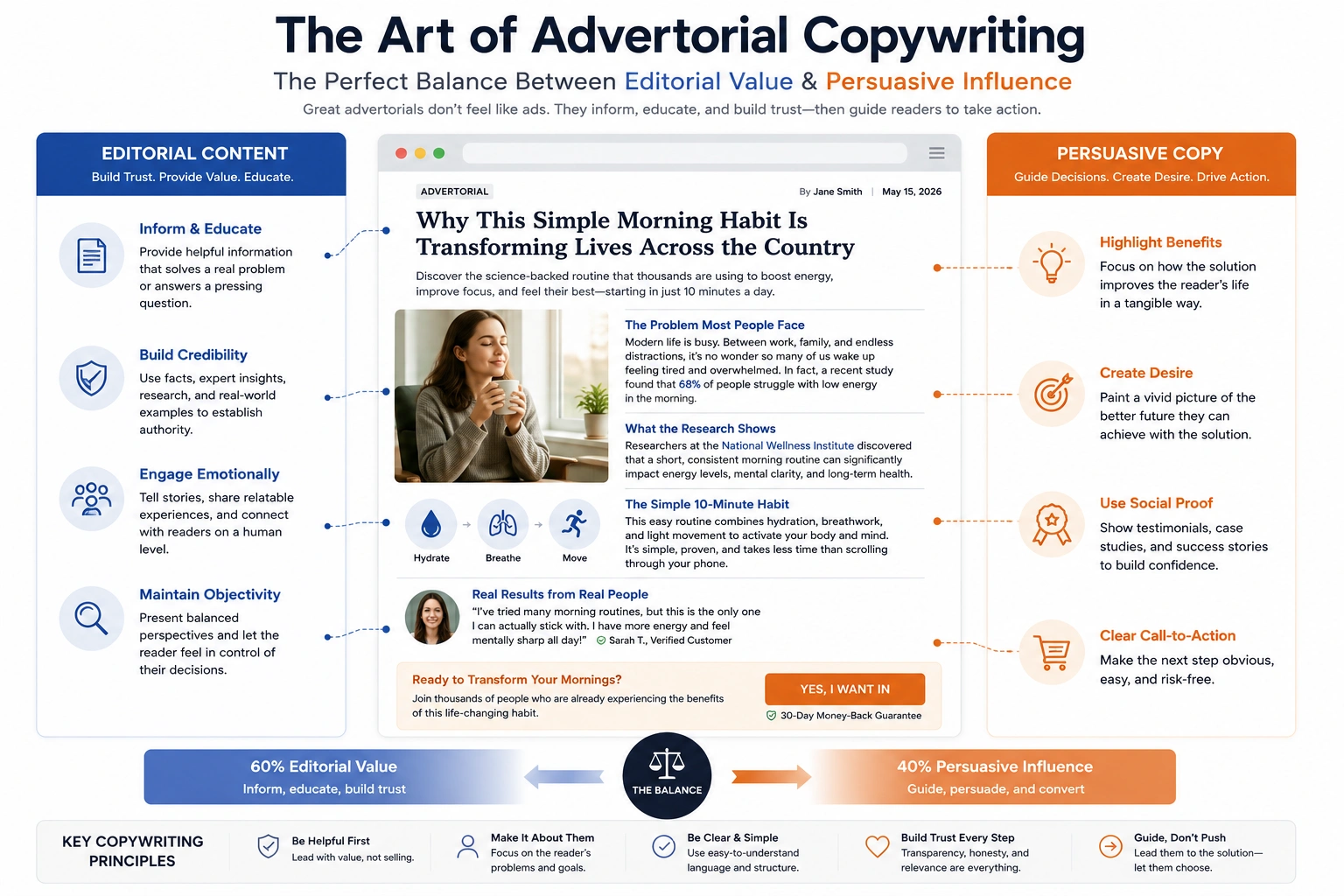
How to Write an Advertorial: Copywriting Framework
Advertorial copywriting is not simply sales copy placed inside an article layout. The job is to help a specific reader understand a problem, assess a possible solution, and decide whether to take the next step—without disguising the commercial purpose of the page.
This guide shows you how to write an advertorial from brief to final review, with a reusable structure, headline examples, a worked outline, and a practical testing checklist.
Start with the audience and offer, choose one supportable angle, write an accurate headline, deliver useful information, connect the solution to the reader's problem, disclose commercial relationships clearly, and finish with one relevant call to action. Test the result rather than assuming a formula will convert.
What Is Advertorial Copywriting?
Advertorial copywriting uses an informative, article-like format to explain or evaluate a product, service, or offer. It can use reporting, explanation, comparisons, demonstrations, or a clearly identified personal account. The editorial format does not remove the need to make advertising relationships clear.
A useful advertorial gives readers information they can evaluate even if they do not buy. It distinguishes verified facts from opinion, explains limitations when they matter, and avoids inventing research, customer experiences, or performance results.
How to Write an Advertorial Step by Step
1. Define the reader, problem, and next step
Write a one-sentence brief before drafting:
- Reader: Who is this page for, and what do they already know?
- Problem: What question or decision are they trying to resolve?
- Offer: What product or service is being presented, and what can it credibly do?
- Next step: Should the reader compare options, inspect details, request information, or buy?
If the offer cannot be connected to the reader's problem with clear evidence, improve the brief before writing persuasive copy.
2. Choose one angle you can support
An angle determines which part of the subject the page explores. Choose it based on the reader's question and the evidence available—not on which story sounds most dramatic.
| Angle | Useful when | What to include |
|---|---|---|
| Problem and explanation | The reader needs to understand why a problem occurs. | A clear explanation, relevant context, and practical options. |
| Comparison | The reader is choosing between approaches or products. | Consistent criteria, trade-offs, limitations, and sources. |
| How-to or demonstration | The reader wants to see how a solution works. | Steps, examples, prerequisites, and realistic limitations. |
| First-person account | A genuine, documented experience is available. | The actual experience, relevant context, and no implication that one result is typical unless supported. |
3. Write a specific, accurate headline
A strong headline tells the right reader what the page covers and gives a fair reason to continue. Curiosity can help, but the headline should not conceal essential information or promise an outcome the article cannot substantiate.
Headline examples you can adapt:
- “How to Compare [Category] Options Before You Choose”
- “[Number] Questions to Ask Before Buying [Product Type]” — use a number only when the article actually answers that many questions.
- “What [Approach] Can—and Cannot—Help You Do”
- “A Practical Guide to Choosing [Product Type] for [Use Case]”
Avoid invented test results, unsupported savings or health claims, fake personal stories, and exaggerated headlines such as “doctors don't want you to know” unless the wording is genuinely accurate and well-supported.
4. Open by matching the reader's expectation
The first paragraph should continue the promise made by the headline. State the question, describe the situation, or explain what the reader will learn. Avoid generic introductions and do not manufacture a personal struggle to create emotional connection.
Simple opening template: “Choosing [product or approach] can be difficult when [specific decision problem]. This guide compares [relevant factors] so you can decide which option fits [use case].” Replace the brackets with details that are true for the actual audience and offer.
5. Deliver the useful information before the recommendation
Use the body to answer the reader's real questions. Depending on the topic, that might mean explaining how something works, comparing alternatives, showing a process, clarifying costs or requirements, or discussing limitations. Do not use an arbitrary rule such as “70% of the page must be informational.” The right balance depends on the reader's intent and the complexity of the decision.
When making factual claims, link to reliable evidence where useful. Do not present a hypothetical example as a real customer result, and do not use invented studies, testimonials, or first-person testing.
6. Introduce the offer transparently
Explain the connection between the information and the product: which reader need it addresses, what it offers, and what the reader should check before deciding. Keep important limitations visible. If the page is sponsored, contains affiliate links, or otherwise has a material commercial relationship, disclose that relationship clearly and prominently in a way appropriate to the context and applicable rules.
Do not imitate a publisher's independent reporting in order to make readers mistake an advertisement for neutral editorial coverage. Native formatting can fit a page's context without hiding its commercial nature.
7. Use a CTA that matches the decision
The call to action should make the next step clear. A reader comparing options may need product details; a reader ready to buy may need to view the offer. Avoid fake scarcity, pressure, or vague links that do not tell the reader what happens next.
One primary CTA is a useful starting point, not a universal law. Place it where it follows naturally from the information and test alternatives when you have enough comparable traffic.
A Reusable Advertorial Structure
- Headline: Accurate topic and reader benefit.
- Opening: The question, problem, or decision the page addresses.
- Context: What the reader needs to understand before evaluating solutions.
- Evidence or demonstration: Sources, comparisons, steps, or a genuine documented experience.
- Options and trade-offs: What to consider, including relevant limitations.
- Offer connection: Explain how the promoted product relates to the problem.
- Disclosure: Make sponsorship or affiliate relationships clear where applicable.
- CTA: Give the reader a relevant, transparent next step.
This is a flexible outline, not a mandatory sequence. A short comparison article may not need a long story; a technical product may need more explanation before the recommendation.
Advertorial Copywriting Example: Build an Outline, Not a Fake Testimonial
Imagine a company selling a home-office desk accessory. A responsible advertorial could be structured like this:
- Headline: “What to Check Before Choosing a Desk Accessory for a Small Workspace”
- Opening: Explain the practical space or setup problem.
- Useful content: Compare dimensions, compatibility, setup requirements, and materials using verified product specifications.
- Trade-offs: Explain who may benefit and who may need a different option.
- Offer: Identify the product and link to accurate specifications and current terms.
- CTA: “View dimensions and compatibility.”
The example shows structure only. It does not claim that the product improves productivity or produces a particular sales result.
Common Advertorial Copywriting Mistakes
- Inventing authority: Do not claim years of experience, testing, research, or campaign results that cannot be verified.
- Disguising advertising: Do not make readers believe sponsored content is independent editorial reporting.
- Overpromising: Specific numbers, health outcomes, financial outcomes, and comparisons need appropriate evidence.
- Using curiosity without substance: The page must answer the question that earned the click.
- Following rigid word-count rules: Write to the information need; remove repetition and filler.
- Assuming a formula guarantees results: PAS, problem-solution, storytelling, and comparison structures are drafting aids—not proof of effectiveness.
- Ignoring the destination: The advertorial's message should match the product page, offer, and claims readers see after clicking.
How to Test and Improve Advertorial Copy
Measure the page against the goal of the campaign. Keep the comparison as fair as possible: if you change the headline, audience, offer, and landing page at the same time, it becomes difficult to identify what caused a difference.
| What to review | What it can tell you |
|---|---|
| Ad click-through rate (CTR) | Whether the ad creative and headline attract clicks; it does not prove the page itself persuades readers. |
| Engagement and scroll behavior | Whether visitors appear to reach key information; interpret analytics carefully and respect consent/privacy requirements. |
| CTA click rate | Whether readers proceed from the article to the next step. |
| Conversion rate and cost per acquisition | Whether the overall journey produces the intended outcome at an acceptable cost. |
| Traffic and tracking quality | Whether events, attribution, page loading, and destination URLs work as intended. |
Start with one clear hypothesis, such as “a comparison-led headline will attract more qualified visitors than a general benefit headline.” Define the primary metric before the test, check that tracking works, and avoid declaring a winner from a tiny or uneven sample. A copy change can help, hurt, or make no meaningful difference.
Disclosure and Native Advertising Policies
Disclosure obligations and platform rules depend on the relationship, jurisdiction, product category, and campaign. Review the requirements that apply to your situation rather than treating a generic checklist as legal advice or a guarantee of approval.
- FTC guidance on native advertising explains how advertising should be identifiable to consumers in the United States.
- Taboola policies provide the network's current policy resources.
- Outbrain advertiser resources are a starting point for campaign requirements; check its current policies before launch.
These links are reference points, not a promise that any particular page or claim will be accepted. Recheck current rules before publishing or launching a campaign.
Advertorial Copywriting Checklist
- The audience, problem, offer, and intended next step are defined.
- The headline accurately reflects the page.
- The opening delivers on the headline's promise.
- Claims and figures are supported, and sources are linked where useful.
- Any personal story or testimonial is genuine and used with permission.
- Commercial relationships are disclosed clearly where applicable.
- The page explains relevant limitations and does not imply guaranteed outcomes.
- The CTA tells readers what they can do next.
- The destination page matches the advertorial's message and offer.
- Links, analytics, mobile layout, and tracking have been checked.
FAQ: Advertorial Copywriting
Related Resources
- What Is an Advertorial Landing Page?
- How to Write an Advertorial That Converts
- Advertorial Examples
- CRO for Native Ads: Optimizing Your Funnel
- Mobile Advertorial Optimization
Effective advertorial writing starts with a real reader need, useful information, supportable claims, transparent commercial intent, and a clear next step. Use a structure to organize the draft, then let evidence and campaign data—not promises or formulas—guide the revisions.