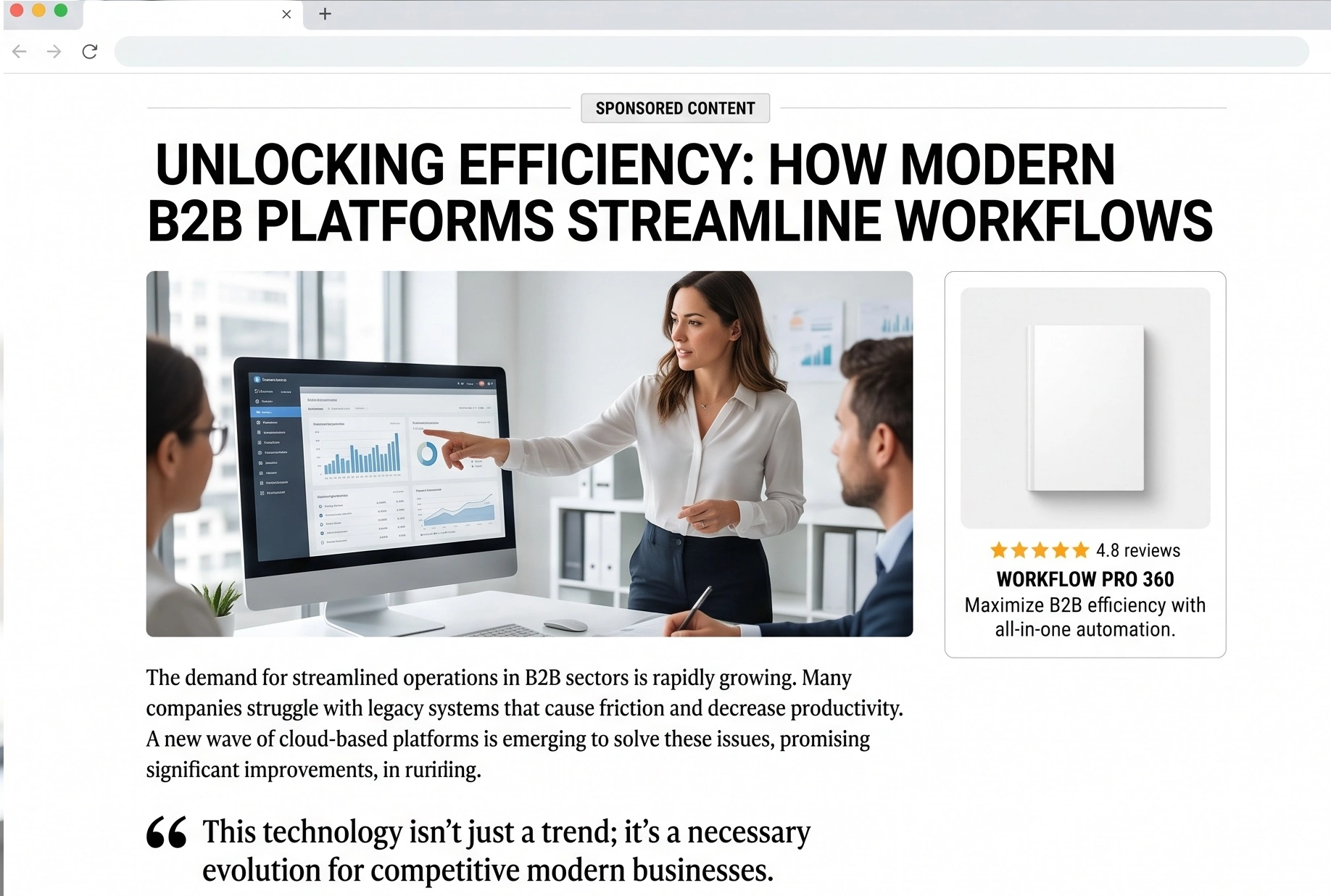
Native Ads Advertorial Examples: 5 Formats Analyzed
When you search for native ads advertorial examples, you need more than a collection of attractive headlines. You need to understand the relationship between the ad a person clicks, the page they land on, the evidence the page provides, and the next action it asks them to take.
This guide combines one publicly documented native advertising case study with four practical advertorial formats you can use as analysis frameworks. The four format examples are illustrative structures, not claims about specific campaigns or measured results. Where performance data is mentioned, the source and limits of that evidence are stated.
The goal is not to copy another advertiser’s words or disguise paid content as independent journalism. It is to identify useful structural choices, build a page that fulfils the ad’s promise, disclose commercial intent clearly, and test your own version with real campaign data.
What Makes a Useful Native Ad Advertorial Example?
A useful example lets you inspect the path from the ad creative to the landing page. A headline alone can show an angle, but it cannot tell you whether the page fulfils the promise, supports its claims, or helps the visitor make an informed decision.
1. Message Match Between the Ad and the Page
Compare the ad’s headline and image with the landing page’s headline and opening paragraph. The visitor should quickly recognize the topic they clicked for. If an ad promises a comparison, the page should provide a meaningful comparison; if it promises an explanation, the page should explain the subject before pushing an offer.
2. Evidence That Supports the Claim
Look for product specifications, a transparent comparison method, relevant research, verifiable testimonials, or clearly described first-hand testing. Specific details are useful only when they are true and can be supported. Never invent testing periods, expert quotes, clinical findings, customer stories, or statistics to make a page look credible.
3. A Clear Commercial Transition
An advertorial can use an article-like structure while still making its commercial purpose clear. A visible “Advertisement,” “Sponsored,” or similarly understandable disclosure helps readers recognize paid content. Editorial styling should support readability—not conceal who is promoting the offer.
4. A Next Step That Fits the Story
The call to action should follow naturally from the information provided. “View product details” may fit an educational product page; “Compare plans” may fit a comparison article. There is no universally best CTA wording or position. Treat each choice as a hypothesis to test.
Five Native Ad Advertorial Examples and Formats to Study
The first example below is based on a public case study published by Taboola. The remaining four are clearly labelled illustrative formats. They demonstrate how to analyze an advertorial without pretending that a hypothetical page is a real campaign or that its performance has been measured.
Example 1: Bedrop’s Native Advertising Campaign — A Documented Case Study
Source: Taboola’s Bedrop case study.
Bedrop is a Germany-based family business selling bee-based cosmetics and beauty products. In its published case study, Taboola reports that Bedrop used native ads to reach audiences beyond its usual search and social channels. The company tested image and motion ads, and the case study describes long-form advertorial landing pages that included video and customer testimonials.
Taboola reports a 77% increase in revenue and a 33% increase in website sessions from native advertising, as well as a 35% higher average order value compared with Meta and Google. These are results reported by the advertising platform in its own case study—not independently verified benchmarks and not a promise of what another advertiser should expect.
What to study:
- Creative testing: The case study says Bedrop tested ad creatives and found that simple, direct titles and visuals featuring men drove more clicks.
- Landing-page depth: The reported use of long-form advertorials, video, and testimonials suggests the team tested ways to explain the products before the next step.
- Measurement: Revenue, website sessions, average order value, and conversion activity answer different questions. Do not treat a click increase as proof of profitable sales.
What this case does not prove: It does not establish that every long-form advertorial will outperform a product page, or that the same creative will work for a different audience, offer, or market. Read the original case study for the publisher’s full account.
Example 2: The Problem–Solution Advertorial — Illustrative Format
Use case: A product or service that solves a specific, familiar problem. The following is a structural example, not a real campaign.
Illustrative headline: “Choosing a Home Air Purifier? Five Features Worth Comparing.”
Possible structure:
- Define the reader’s problem in plain language.
- Explain the factors that affect the decision.
- Compare relevant options using consistent criteria.
- Show where the featured product fits—and where it may not.
- Offer a clear next step, such as viewing specifications or comparing models.
What to analyze: Does the opening address the question raised by the ad? Are the comparison criteria visible? Are product claims supported by manufacturer documentation or another reliable source? Does the page acknowledge relevant limitations instead of presenting the promoted product as the only reasonable choice?
What to test: Compare a problem-led opening with a comparison-led opening while keeping the audience, offer, and other major variables consistent. Evaluate qualified engagement and downstream conversions, not clicks alone.
Example 3: The Educational Explainer — Illustrative Format
Use case: An offer that needs explanation before a reader can assess its relevance. This is a reusable framework, not a documented campaign.
Illustrative headline: “What to Check Before Choosing an Email Marketing Platform.”
Possible structure:
- Answer the main question the headline raises.
- Explain two or three decision criteria with accurate, useful detail.
- Show how different needs can lead to different choices.
- Introduce the relevant product as one option, with verifiable features.
- Link to fuller specifications, a comparison, or a product demo.
What to analyze: Does the reader receive useful information before the sales message? Are facts distinguished from opinions? Can the reader understand the product’s role without accepting unsupported claims?
What to test: Try different explanatory openings or evidence orders. Keep the claims accurate and the commercial disclosure visible in every variant.
Example 4: The Story-Led Advertorial — Illustrative Format
Use case: A product whose context or use is easier to understand through a narrative. This example is fictional and should not be presented as a real customer experience.
Illustrative headline: “The Checklist Our Small Team Created Before Replacing Its Project Management Tool.”
Possible structure:
- Introduce a realistic situation and the decision to be made.
- Explain the constraints and criteria that shaped the choice.
- Describe the options considered and the reasons for the decision.
- Connect the selected product’s actual features to those criteria.
- Invite readers to review the same criteria for their own situation.
What to analyze: Does the story clarify a real decision, or does it invent drama to make the offer seem necessary? If the page uses a customer story, confirm that the person, experience, and quoted statements are genuine and used with permission.
What to test: Compare a narrative introduction with a direct educational introduction. Do not fabricate first-person experience or imply that a fictional story is a testimonial.
Example 5: The Comparison or Listicle Advertorial — Illustrative Format
Use case: Readers who are already comparing alternatives. This is an illustrative page structure, not a ranking of real products.
Illustrative headline: “Four Factors to Compare Before Choosing a Website Hosting Plan.”
Possible structure:
- State the comparison criteria before presenting the options.
- Apply the same criteria to each relevant option.
- Link factual claims to product documentation or reliable evidence.
- Explain who each option may suit, including meaningful trade-offs.
- Disclose any commercial relationship that could affect the recommendation.
What to analyze: Are the criteria consistent? Are sponsored or affiliated options disclosed? Are weaknesses omitted selectively? A listicle is useful when it helps the reader compare—not when it disguises a single-product pitch as an independent ranking.
What to test: Compare a short criteria-first page with a more detailed comparison page. Use the same transparent evaluation criteria and track downstream outcomes.
How to Analyze an Advertorial Step by Step
Use this checklist whenever you save an example. Record observations separately from assumptions so that your swipe file becomes a research tool rather than a collection of attractive screenshots.
Step 1: Record the Source and Context
- Save the original URL and the date you viewed it.
- Record the advertiser and network or publisher when you can verify them.
- Capture the ad creative and landing page, subject to applicable access and copyright restrictions.
- Mark any missing information instead of guessing.
Step 2: Map the Message Match
Write down the promise made by the ad, the page headline, and the first substantive answer on the page. Ask whether the visitor receives what the ad led them to expect. Note any shift in subject, offer, or claim.
Step 3: Map the Page Structure
Label the main sections: opening, problem or context, explanation, evidence, product introduction, limitations, disclosure, and CTA. Not every page needs every section, and the order should fit the reader’s question and the complexity of the offer.
Step 4: Check the Evidence and Disclosure
Identify the support behind each important factual claim. Look for original research, product documentation, a transparent method, or genuine customer evidence. Also check whether the page clearly identifies sponsored or paid content and any relevant affiliate relationship.
Step 5: Turn the Observation Into a Test
Write one testable hypothesis, such as: “A comparison-led headline may attract more qualified visitors than a broad problem-led headline.” Define the primary metric before launch, keep other variables stable where practical, and use enough data to interpret the result. An observed page structure is a source of ideas—not proof of causation.
Advertorial Formats at a Glance
| Format | Best suited to | What to inspect | Key risk |
|---|---|---|---|
| Documented case study | Learning from a reported campaign | Source, methods, metrics, limitations | Treating a vendor-reported result as universal |
| Problem–solution | A specific pain point | Problem clarity and evidence for the solution | Exaggerating the problem or promise |
| Educational explainer | Complex products or decisions | Usefulness, clarity, product transition | Disguising promotion as independent advice |
| Story-led | Context-rich decisions | Authenticity and narrative relevance | Invented testimonials or first-person claims |
| Comparison or listicle | Readers evaluating alternatives | Consistent criteria and balanced evidence | Biased rankings presented as neutral |
How to Build Your Own Native Ad Swipe File
A useful swipe file should help you answer a research question. Save fewer examples if necessary, but annotate each one consistently.
What to Save for Each Example
- Original URL, advertiser, network or publisher, and date observed.
- Ad headline, image description, and visible disclosure.
- Landing-page headline, opening, section order, proof, and CTA.
- Any public performance information, with its source and limitations.
- Your interpretation, clearly separated from observed facts.
- One original idea to test for your own product or audience.
Where to Find More Examples
Start with Taboola’s case studies for publisher-reported campaign accounts and Outbrain’s official resources for platform context. Competitive-intelligence services such as Anstrex and AdPlexity may help you discover creatives and destination pages, depending on their current coverage and subscription. Verify the source and date of every example you use.
Learn From the Structure, Not by Copying the Page
Use examples to understand how a headline frames a problem, how evidence is introduced, or how a page guides the reader. Create original copy and visuals, verify your claims, respect intellectual property, and disclose paid relationships. A template is a starting point—not proof that a page will convert or comply with a platform’s rules.
What to Test in Your Own Advertorial
Test the Headline and Opening
Compare two accurate angles that address the same audience need. Make sure the landing page fulfils the promise in the ad. Avoid sensational claims that the page cannot substantiate.
Test Page Flow and CTA
Test whether readers benefit from seeing the explanation, comparison, or product details in a different order. CTA placement and wording depend on the offer, the audience, and the page; there is no reliable universal rule that one fixed percentage of page depth always performs best.
Measure the Full Funnel
Track metrics that reflect the actual objective: click-through rate, engaged visits, outbound clicks, leads or purchases, conversion rate, and cost per result where available. A higher click-through rate can coexist with lower-quality traffic, so do not judge a page by a single metric.
Keep the Test Interpretable
Define the hypothesis and primary metric before starting. Change one meaningful variable at a time when practical, document the test period and sample size, and avoid declaring a winner from a handful of clicks. Repeat tests when conditions or audience segments differ materially.
Transparency and Compliance Considerations
Native advertising can use an editorial format, but its paid nature should not be hidden. Use clear disclosures that readers can notice and understand. Make sure the headline and image accurately represent the destination, and substantiate claims about product features, health, finances, performance, or customer outcomes.
Platform rules vary by network, country, product category, and campaign. Review the current policies for the platform and jurisdiction relevant to your campaign. No template or page format can guarantee approval, and a page that passed review once may still need changes later.
Use a customizable structure as a draft, then adapt the copy, evidence, disclosure, and page flow to your own offer. A template can save setup time, but its performance still needs to be tested.
Frequently Asked Questions About Advertorial Examples
An advertorial example is a paid or commercially motivated page that uses an article-like format to explain a product, service, or offer. A useful example shows the page structure, its evidence, its disclosure, and the next action—not just a headline or screenshot.
A native ad is the paid placement or creative designed to fit its surrounding environment. An advertorial is the article-style content a visitor may reach after clicking that ad. A campaign can use both, and the ad’s promise should match the destination.
Start with official platform resources and published case studies. Competitive-intelligence tools can also help you inspect creatives and destination pages. Record the source and date, and remember that an ad’s continued presence does not prove that it is profitable.
Compare the ad’s promise with the page headline and opening. Map the sections, check the evidence behind important claims, look for clear commercial disclosure, and evaluate whether the CTA fits the information provided. Separate what you can observe from assumptions about performance.
Use another page for research, not as text or design to copy wholesale. Create original copy and visuals, respect intellectual property, verify your claims, and adapt the underlying idea to your own audience and offer.
No. A screenshot or a live ad reveals only part of the campaign. Profitability depends on spend, revenue, margins, attribution, audience quality, and other factors that may not be public. Treat examples as sources of hypotheses unless reliable performance data is available.
Turn Your Research Into a Better Page
The most useful advertorial examples do more than create curiosity. They help you understand the audience’s question, the evidence needed to answer it, and the next step that makes sense. Study the structure, verify the claims, disclose commercial intent, and test your own version.
If you need a starting point, you can browse customizable advertorial templates. If you need a page built around a specific offer, request a custom advertorial build. Neither option guarantees campaign results; the page should be adapted and evaluated against your own data.
Related Resources: