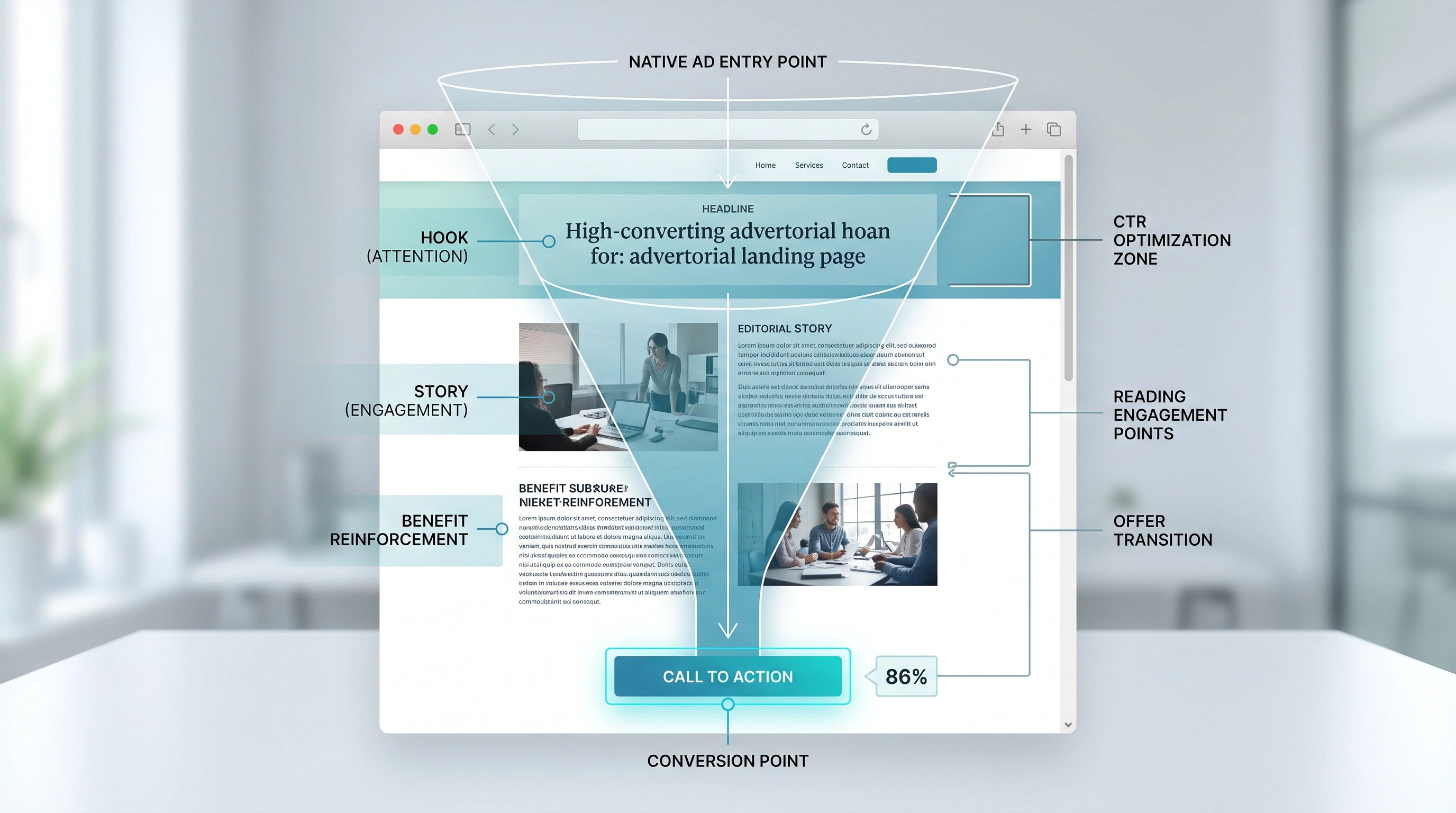
Advertorial CRO: A Practical Optimization Framework
Advertorial conversion rate optimization (CRO) is the process of finding and fixing the points where a reader’s expectations, the page experience, and the offer stop matching. The goal is not to make an advertorial look like independent journalism. It is to make the page relevant, useful, transparent, and easy to act on.
For native-ad campaigns, start with the whole journey: the ad promise, the first screen of the advertorial, the evidence presented, the offer transition, and the destination after the click. A page can have polished copy and still underperform if one of those steps creates confusion or friction.
Change one meaningful variable at a time, define the metric before the test, and compare results only when traffic and tracking are adequate. Without reliable campaign data, treat recommendations as hypotheses—not proven lifts.
What to diagnose before rewriting the page
Do not begin by changing the headline, page length, and CTA together. First identify where the journey is breaking. Review the available evidence in this order:
- Ad-to-page message match: Does the opening answer the question or promise that earned the click?
- Engagement: Do visitors reach the main explanation, comparison, or proof section?
- Offer interaction: Do readers click the offer CTA, and does that click lead to the intended destination?
- Downstream outcome: Are offer clicks turning into qualified leads, purchases, or another defined conversion?
- Technical friction: Do mobile layout, loading, forms, redirects, or tracking prevent the intended action?
Use analytics and ad-platform reports where available. If you have no reliable data yet, run a structured QA review and establish a baseline before making performance claims.
1. Fix message match between the ad and advertorial
The headline, image, and opening paragraph should continue the same topic and expectation as the ad. This does not mean repeating sensational wording or promising a result the page cannot substantiate. It means answering the reader’s reason for clicking quickly and accurately.
| Ad promise | Weak page opening | Better page opening |
|---|---|---|
| Compare options for a specific need | A broad introduction to the entire category | State the comparison criteria and which reader each option may suit |
| Explain how a product works | A dramatic claim followed by a long sales pitch | Explain the mechanism in plain language, including limits and evidence |
| Help solve a recurring problem | Immediately insist that one product is the only answer | Clarify the problem, outline relevant approaches, then explain where the offer fits |
Review the actual ad and landing page side by side. Remove any promise that the page does not deliver, and make sure important qualifications are not hidden below the CTA.
2. Build a page structure that earns the next scroll
There is no universal advertorial layout or word count that suits every offer. Use only sections that help the reader understand the problem, assess the solution, or decide what to do next.
- Clear opening: Identify the reader’s question and deliver on the ad’s promise.
- Useful explanation: Provide context, selection criteria, or a practical framework—not filler.
- Evidence: Support material claims with relevant sources, product documentation, real demonstrations, or clearly attributed customer evidence.
- Limitations and alternatives: Explain who the offer may not suit and what readers should compare.
- Offer bridge: Connect the information to the product or service without pretending the commercial relationship does not exist.
- Specific CTA: Tell readers what happens after clicking, using accurate language.
Personal stories and first-person reviews should be used only when they reflect a real experience that can be substantiated. Do not invent a test, customer, expert endorsement, result, price, or guarantee to make the page feel credible.
3. Make the offer transition clear and relevant
A CTA should feel like the next useful step—not a surprise switch from an article into an unrelated pitch. Explain why the offer is relevant, what the reader will receive, and any material conditions needed to make an informed decision.
Example: from explanation to offer
Context: An advertorial explains how to compare project-management tools for a small team.
Weak transition: “This is the best tool. Buy now.”
Stronger transition: “If your team needs shared task ownership and a single project view, review this tool’s current features and plan limits before deciding whether it fits.”
The second version is not guaranteed to convert better. It is a clearer testable hypothesis: relevance and transparent expectations may help readers make a more informed next-step decision.
4. Improve mobile usability and page speed
Check the real landing page on a phone, not only in a desktop preview. Make sure the headline is readable, paragraphs are manageable, tables can be used on small screens, the CTA is easy to find, and important content is not obscured by overlays or sticky elements.
- Resize and compress images while preserving acceptable visual quality.
- Remove scripts, embeds, and widgets that are not needed for the page’s purpose.
- Check font loading, layout shifts, redirects, and third-party requests.
- Test the live URL with PageSpeed Insights and inspect the field data when available.
- Test the CTA, forms, analytics events, and destination URL on mobile and desktop.
Do not rely on a universal “three-second rule,” a fixed page-size limit, or a target score as proof that conversions will improve. Performance metrics help diagnose technical issues; business impact must be measured separately.
5. Treat design as a usability and transparency decision
A clean, readable editorial-style layout can support long-form explanation, but a paid advertorial should not impersonate independent reporting or hide its commercial purpose. Use accurate bylines, truthful publication details, clear advertising or sponsorship disclosures where applicable, and a visual hierarchy that helps readers understand the content.
Avoid fake news branding, fabricated author credentials, false urgency, misleading testimonials, deceptive buttons, or design choices that make an advertisement appear to be independent editorial content. Check the current requirements that apply to your publisher, offer, location, and traffic source. Relevant starting points include Taboola’s landing-page policies, Outbrain’s advertising guidelines, and the FTC’s native-advertising guidance. These links are starting points, not a guarantee of approval.
6. Measure the full funnel—not just the CTA click
Choose a primary outcome that matches the business goal. A high click-through rate on the advertorial CTA is not enough if the destination fails to generate qualified leads or purchases.
| Metric | What it helps diagnose | Check before interpreting |
|---|---|---|
| Landing-page engagement | Whether visitors reach meaningful content | Define the engagement event and verify it fires consistently |
| Offer click-through rate | Whether readers proceed to the offer | Confirm clicks are not duplicated and the destination works |
| Lead or purchase conversion rate | Whether downstream visitors complete the goal | Use a consistent conversion definition and attribution window |
| Cost per acquisition (CPA) | How much spend is associated with each acquisition | Check spend, attribution, refunds, and lead quality where relevant |
| Return on ad spend (ROAS) | Revenue attributed to ad spend | Do not treat ROAS as profit; account for margins and other costs separately |
| Technical error rate | Broken links, failed forms, or tracking problems | Test on real devices and across the full click path |
Record the baseline, test dates, traffic source, audience, offer, and the single main change. Avoid calling a result a winner when the sample is too small, tracking changed mid-test, or other campaign variables also changed.
7. Run a controlled advertorial CRO test
Use this sequence to make tests interpretable:
- Write the problem statement: Describe the observed friction without assuming its cause.
- State the hypothesis: For example, “Making the comparison criteria visible earlier may help more readers reach the offer.”
- Change one main variable: Such as the opening section, evidence presentation, CTA wording, or mobile layout.
- Choose the primary metric first: Use a metric close enough to the hypothesis to test it, while monitoring the final business outcome.
- Keep the test conditions comparable: Avoid changing the audience, bid strategy, offer, and page simultaneously.
- Document the result and uncertainty: Keep the change only when the evidence supports it and no important downstream metric worsens.
If traffic volume is limited, prioritize broken links, unclear claims, slow or unstable components, confusing offers, and tracking errors before attempting subtle copy experiments.
8. Use this pre-launch audit checklist
- [ ] The page fulfills the ad’s actual promise near the beginning.
- [ ] Product, health, financial, and performance claims have appropriate support.
- [ ] Testimonials, reviews, author details, and examples are genuine and accurately represented.
- [ ] Paid or sponsored content is disclosed clearly where required.
- [ ] The offer, price, terms, and CTA destination are consistent.
- [ ] Mobile text, images, tables, forms, and buttons work as intended.
- [ ] Analytics events and conversion tracking have been tested.
- [ ] Current policies relevant to the campaign have been reviewed.
- [ ] A baseline and a primary success metric are documented before testing.
When to use a template—and when to commission a custom page
A template can be a useful starting point when you need a familiar layout, a faster build, or a structure to adapt. It still needs to be rewritten and tested against your offer, audience, evidence, brand, and traffic source. A custom build may make sense when the funnel needs a distinctive structure, integrations, or offer-specific content. Neither option guarantees approval or conversion performance.
Browse the 600+ advertorial template collection if you want a starting structure, or request a custom advertorial landing page if you need a page built around a specific campaign.
Related resources
- What Is an Advertorial Landing Page?
- How to Write an Advertorial
- Advertorial Examples
- Native Ads Funnel Guide
- Advertorial Templates
- Advertorial vs. Landing Page
The practical takeaway
Advertorial CRO works best as a disciplined diagnosis process: align the ad and page, make the explanation useful, substantiate claims, disclose the commercial relationship, remove technical friction, and measure what happens after the CTA. No headline, layout, template, or word count can guarantee a result. Use the evidence from your own funnel to decide what to improve next.