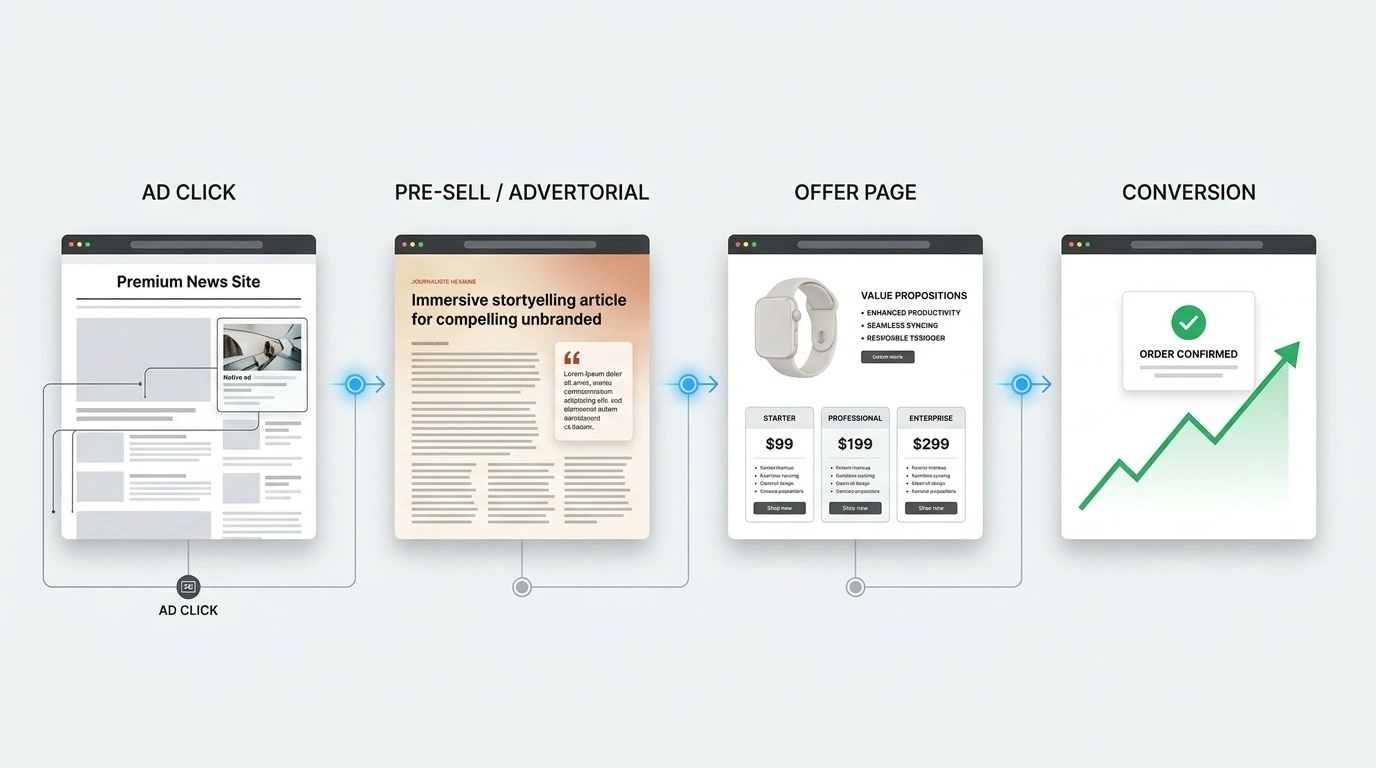
Native Ads Funnel: How to Build and Optimize the Journey
Native advertising can generate inexpensive clicks and still produce an expensive campaign.
The problem is often not the traffic source.
It is the handoff.
A user sees a native ad, clicks because the headline creates curiosity, lands on a page that feels different from the ad, encounters a sales pitch too early, and leaves. The media buyer then blames the publisher, targeting, or traffic quality.
That diagnosis is often wrong.
A profitable native ads funnel follows one principle: every step prepares the user for the next.
The ad earns the click. The pre-sell earns attention. The advertorial builds understanding. The conversion page turns intent into action.
If you need execution rather than another strategy document, you can also use a Fiverr advertorial landing page service to build the post-click experience around your traffic source and offer.
This guide focuses on decisions that can be applied to a campaign: which page the click should reach, what the visitor still needs to understand, and how to locate the step where qualified intent is lost. It does not assume that one funnel structure works for every offer.
What Is a Native Ads Funnel?
A native ads funnel is the sequence of pages, messages, and conversion steps that moves a user from a native ad click to a desired business outcome.
The simplest version is:
- Native ad
- Pre-sell or advertorial
- Offer/conversion page
- Conversion
- Optional retargeting or follow-up
The funnel is not just a collection of pages. It is a continuity system.
The ad creates an expectation. The landing experience must fulfill it.
A native ad headline promising a useful explanation should not send the visitor directly to a hard sales page unless the ad has already created sufficient buying intent. An ad that explicitly promotes a product may not need a long editorial detour.
The right funnel depends on how much persuasion the user needs before converting.
The four questions every native funnel should answer:
- Why did the user click?
- What did they expect to see after the click?
- What information do they need before taking action?
- What is the lowest-friction next step?
If these answers do not align, the funnel has a structural problem.
The Core Native Ads Funnel Architecture
The most reliable architecture for cold native traffic is usually:
Native Ad → Pre-Sell/Advertorial → Conversion Page → Offer
Native traffic often arrives before the user has strong purchase intent.
The pre-sell converts attention into qualified intent before the final action.
- Native ad: wins attention and qualifies the click.
- Pre-sell: creates context and resolves the first layer of objections.
- Advertorial: educates, reframes the problem, and introduces the solution.
- Conversion page: handles the transaction or lead capture.
- Retargeting: recovers users who developed intent but did not convert.
Not every campaign needs every layer.
A simple offer with an obvious value proposition may convert directly from native traffic.
A complicated SaaS product, affiliate offer, high-consideration DTC product, or unfamiliar solution often benefits from an intermediate page.
The problem is not using too many pages.
The problem is using a page with no clear job.
Browse 600+ ready-to-customize HTML advertorial templates across different niches and funnel structures, then adapt the page to your offer, audience, and traffic source.
Why Native Traffic Needs a Different Funnel
Native traffic differs from bottom-of-funnel search traffic because users are often consuming content rather than actively searching for a product.
Native traffic usually needs more context before a conversion request becomes reasonable.
- Search traffic can arrive with explicit commercial intent.
- Native traffic often begins with curiosity or problem awareness.
- The ad therefore carries less purchase intent by default.
- The post-click page must develop that intent without breaking the original promise.
- A strong funnel separates curiosity from qualification instead of treating every click as a buyer.
This is why a native campaign can have an attractive CTR and weak economics.
A headline may generate curiosity without generating commercial intent.
For example:
High-curiosity angle: "Doctors Are Rethinking This Common Daily Habit"
Higher-intent angle: "How a New Approach Helps Reduce the Daily Problem Behind X"
The first may generate more clicks.
The second may generate fewer clicks but better downstream economics.
For a media buyer, the second metric matters more.
The goal is not to buy clicks.
The goal is to buy profitable user journeys.
Advertorial vs. Pre-Sell vs. Sales Page
An advertorial, pre-sell page, and sales page can sit in the same funnel. They perform different jobs.
Use an advertorial when the user needs education and belief change. Use a pre-sell when the user needs a shorter bridge. Use a sales page when the user is ready for direct conversion.
- Advertorial: explains, reframes, demonstrates, and builds desire.
- Pre-sell: warms the visitor and creates a reason to continue.
- Sales page: handles objections and asks for the conversion.
- Product page: provides concrete product information and transaction details.
Many campaigns try to make one page perform all of these jobs.
The result is a bloated page with unclear intent.
If you need the conceptual distinction in more depth, see Advertorial vs. Sales Page within the site's existing content cluster.
A practical decision rule: Ask "If I remove the product from this page, is there still a useful piece of information here?" If yes, you may have an advertorial. If no, and the page mainly prepares the visitor for another page, it is probably a pre-sell. If the page's primary purpose is to persuade the visitor to purchase, subscribe, book, or submit, it is functioning as a conversion page.
Native Ads Funnel Comparison
The correct funnel depends on the user's existing intent, the complexity of the offer, and the amount of education required.
| Funnel Type | Traffic Temperature | Best Use | Main Job | Primary Risk |
|---|---|---|---|---|
| Native → Offer | Warm/high intent | Simple offers | Convert immediately | Asking too much too soon |
| Native → Pre-Sell → Offer | Cold | Moderate-consideration offers | Qualify and warm | Weak bridge |
| Native → Advertorial → Offer | Cold | Complex or trust-dependent offers | Educate + persuade | Excessive length |
| Native → Advertorial → Sales Page | Cold | High-consideration offers | Build belief, then close | Message repetition |
| Native → Lead Magnet → Follow-Up | Cold | SaaS/services | Capture intent | Low-quality leads |
There is no universal "best" architecture.
The correct architecture removes the largest conversion barrier with the smallest amount of additional friction.
That is the operating principle for funnel design.
How to Build a Native Ads Funnel Step by Step
Building the funnel should start with the conversion event, not the ad.
Start at the bottom of the funnel and work backward: Define the conversion → identify the objections → create the post-click experience that resolves those objections.
- Step 1: Define the conversion. Decide what counts as success. Examples include purchase, lead submission, free trial, demo booking, application, affiliate click, subscription, or product quiz completion. Do not optimize the native campaign before this is defined. A click is a traffic event. A conversion is a business event.
- Step 2: Identify the dominant objection. Every offer has a barrier. It may be: "I don't believe this works," "I don't understand how it works," "I already tried alternatives," "This looks expensive," "I don't trust the company," "I don't have the problem badly enough," or "I don't know which option is right for me." The advertorial or pre-sell should address the dominant objection, not provide a generic product description.
- Step 3: Choose the bridge page. Use a short pre-sell when the problem is primarily context. Use an advertorial when the problem is belief. Use a direct landing page when the user already understands the problem and the offer. This is one of the highest-leverage decisions in the native funnel.
- Step 4: Build the ad around the first information gap. The native ad should not tell the entire story. It should create a legitimate information gap that the landing page closes. For example, Ad: "Why the usual approach to X may be failing". Landing page: Explains why the conventional approach fails, what the alternative is, and where the product fits. That creates a coherent transition.
The Message-Match Rule & Timeline
Message match means the promise, language, problem, and emotional frame established by the ad continue into the landing experience.
The first screen of the post-click page should make the visitor feel that they landed where the ad told them they would.
Check these five elements:
- Headline continuity
- Problem continuity
- Visual continuity
- Vocabulary continuity
- Expected next step
If the ad talks about a "new method," the landing page should explain the method.
If the ad promises "three reasons," the page should provide those reasons.
Do not use curiosity as an excuse for bait-and-switch. Native funnels perform better when curiosity leads to useful information rather than disappointment. This is also where How to Write an Advertorial becomes useful.
Think of the funnel as a sequence of psychological transitions rather than a sequence of URLs: Ad → Attention → Curiosity → Relevance → Understanding → Belief → Intent → Action
0–3 seconds
Attention
First interaction
Curiosity
Click
Expectation
First screen
Relevance
Early content
Understanding
Middle of page
Belief
Offer transition
Intent
CTA
Action
The timeline exposes a common mistake: placing the CTA before the user has enough reason to care. A CTA is not a substitute for intent.
Where Native Funnels Usually Leak
Most funnel problems fall into predictable categories. The largest leaks occur when one stage is optimized independently instead of optimizing the transition between stages.
Leak 1: High CTR, poor conversion. The ad is attracting curiosity but not qualified intent. Possible causes: Overly sensational headline, misleading image, broad targeting, promise does not match offer, or user expected information but received a sales pitch. The solution is not automatically a better landing page. First inspect the quality of the promise made by the ad.
Leak 2: Good clicks, high bounce. The landing page is failing the expectation test. Check: Does the headline continue the ad? Does the page load quickly? Is the main point visible immediately? Does the first screen look trustworthy? Is the visitor forced through unnecessary friction?
Leak 3: Strong engagement, weak conversion. This is often an offer-transition problem. People may enjoy the article but not understand why the product is the logical next step. The advertorial became content marketing instead of performance marketing. The fix is a clearer connection between problem, mechanism, and solution.
Leak 4: Poor mobile performance. Native traffic is frequently consumed in mobile contexts. If the mobile version requires excessive scrolling, loads slowly, uses tiny text, interrupts reading with pop-ups, or makes the CTA difficult to find, the funnel loses users after paying for the click. The site's Mobile Advertorial Optimization content should be treated as part of the implementation layer, not as a cosmetic afterthought.
Leak 5: Cannot scale. Scaling exposes weaknesses that small traffic volumes hide. A funnel may depend on one headline, one publisher, one placement, or one audience segment. When volume increases, performance becomes less predictable. The answer is a testing system, not simply more budget.
How to Measure and Diagnose a Native Ads Funnel
Measure the complete path from impression to business outcome. A click-through rate (CTR) describes the ad's ability to earn clicks; it does not show whether those clicks become customers. Likewise, time on page or article engagement is diagnostic context, not proof of profitability.
| Stage | What to inspect | If performance weakens here |
|---|---|---|
| Ad impression → click | CTR by creative, placement, and audience | Review the angle, clarity, relevance, and whether the promise attracts the intended user. |
| Click → page load | Landing-page views compared with ad clicks; load errors and speed | Check tracking, redirects, page speed, and device-specific failures before rewriting copy. |
| Landing → engaged visit | First-screen relevance, scroll or engagement events, and exits | Check message match, readability, page usefulness, and intrusive friction. |
| Article → offer click | Offer click-through rate and where the offer is introduced | Explain the connection between the reader's problem and the offer; remove unrelated content. |
| Offer click → conversion | Checkout or lead-form completion, conversion rate, and errors | Inspect offer clarity, price and terms, trust, form friction, and consistency with the advertorial. |
| Conversion → economics | CPA, revenue per visitor, and margin where available | Judge the full journey against the campaign's actual economics, not CTR alone. |
Worked diagnostic: clicks are coming in, but sales are not
Scenario (illustrative, not campaign data): A campaign earns clicks, but purchases remain weak. Do not immediately assume that the advertorial is the problem. First confirm that ad clicks are reaching the page and that analytics records the important events correctly. Then follow the evidence down the funnel.
- If clicks do not become page views: investigate loading, redirects, consent or tracking behavior, and broken URLs.
- If visitors arrive but leave immediately: compare the ad promise with the first screen, then check speed and mobile usability.
- If visitors read but rarely click the offer: check whether the page answers a real question and makes the next step relevant and understandable.
- If offer clicks occur but purchases do not: inspect the destination page, price and terms, checkout errors, and the difference between the advertorial promise and the actual offer.
- If conversions occur but the campaign loses money: compare acquisition cost with revenue and margin; review placement-level quality before scaling.
Change one major variable at a time where practical, state the hypothesis before the test, and define the downstream metric that would support the decision. Do not call a test a winner based on a small or unstable sample, and do not apply a universal sample-size rule without considering baseline conversion and the effect you need to detect.
Choose the next test by the bottleneck
Prioritize the earliest stage where reliable data shows a meaningful drop. If the ad attracts the wrong expectation, test the angle or promise. If the page fails the expectation test, improve the first screen. If engagement is healthy but offer clicks are weak, test the explanation and transition. If offer clicks are healthy but sales are weak, investigate the offer page and transaction path before redesigning the advertorial.
Mobile Optimization Is Part of the Funnel
A native funnel is not finished when the desktop page looks good.
The mobile experience should preserve the same message hierarchy while removing unnecessary friction.
Prioritize: Fast initial rendering, Readable typography, Short paragraphs, Clear visual hierarchy, Large enough tap targets, Minimal intrusive elements, Lightweight images, Persistent or strategically repeated CTAs, Easy transitions between advertorial and offer.
Do not simply shrink the desktop design. Rebuild the hierarchy around how the visitor actually consumes the page.
Google's current page-experience guidance also emphasizes mobile usability, Core Web Vitals, secure delivery, and avoiding intrusive elements that interfere with the main content.
Native Funnel Models by Business Type
Different businesses require different levels of persuasion.
DTC Brands: Native Ad → Advertorial → Product Page → Purchase. This works when the product needs explanation or when the campaign is built around a problem/education angle. The advertorial introduces the problem, why common solutions fail, a mechanism, product introduction, proof, and product transition. The product page handles transaction-specific information.
Affiliate Marketing: Native Ad → Pre-Sell/Advertorial → Affiliate Offer. The biggest risk is creating a page that generates curiosity but does not qualify users for the affiliate offer. The pre-sell should prepare the visitor for what they will see after clicking. If the affiliate offer is radically different from the advertorial promise, conversion will suffer.
SaaS & Services: Native Ad → Educational Article → Product Explanation → Demo/Trial. The intermediate page can focus on the business problem rather than immediately pushing product features. For a service business, a shorter structure can work: Native Ad → Authority/Pre-Sell → Service Landing Page → Lead.
If you want to outsource the actual advertorial/landing-page execution, our native funnel page built through Fiverr is designed around this exact post-click problem rather than simply producing a generic landing page.
FAQ: Native Ads Funnel
Final Native Ads Funnel Checklist & Takeaway
Before launching, confirm: The conversion event is defined. The primary objection is identified. The native ad makes a specific, honest promise. The landing page fulfills that promise immediately. The page type matches the traffic temperature. The advertorial has a real informational purpose. The offer transition is logical. The CTA is clear. Mobile UX has been reviewed separately. Tracking covers the complete funnel. Performance can be segmented by creative, device, placement, and funnel version. Tests have explicit hypotheses. Decisions are based on downstream economics rather than CTR alone.
For deeper implementation, the site's Advertorial CRO content should sit alongside this funnel strategy. Traffic acquisition and post-click optimization should be treated as one operating system rather than two separate projects.