Advertorial vs. Landing Page: Key Differences & When to Use Each
An advertorial and a direct landing page can both be landing pages in the technical sense. The practical difference is the job each page does: an advertorial builds context and evaluates a problem or solution before the commercial next step; a direct landing page puts the offer and primary action front and center.
If you are deciding between an advertorial and a traditional landing page for paid or native traffic, compare visitor awareness, offer complexity, message match, and the amount of explanation needed. Neither format wins by default; the right choice is the one that helps the right visitors make an informed decision with the least unnecessary friction.
Choose an advertorial when visitors need context, education, or a comparison before evaluating an offer. Choose a direct landing page when the visitor already understands the offer and is ready to act. Test both when the answer is uncertain.
Advertorial vs. Landing Page: The Core Difference
An advertorial is a commercial article: it explains a problem, presents useful context, and may recommend a product or service. Its commercial purpose should not be hidden. A landing page is a destination built around a defined conversion goal, such as buying, booking a demo, or submitting a form.
| Factor | Advertorial | Direct landing page |
|---|---|---|
| Main job | Explain, educate, compare, or build context | Present the offer and prompt one main action |
| Useful when | The reader needs more information before deciding | The reader already understands the offer or has high intent |
| Typical content | Problem framing, evidence, comparison, limitations, recommendation | Offer, benefits, proof, price or terms, objections, CTA |
| Main risk | Too much story or weak connection to the offer | Asking for action before key questions are answered |
| What to measure | Engaged reading, offer clicks, qualified downstream conversions | Conversion rate, lead or purchase quality, CPA or ROAS |
Where Examples Fit in the Decision
This page focuses on choosing between page types, not cataloguing example layouts. For annotated advertorial formats and a practical teardown checklist, see the dedicated guide: native ads advertorial examples. Use those examples to generate hypotheses, not as proof that a page will perform the same way in your campaign.
How to Choose the Right Page for Your Traffic
Traffic source is a useful clue, not a rule. A native-ad visitor may need an explanation, while another may respond well to a direct offer. Search traffic also varies: a broad informational query differs from a query naming a specific product or asking for pricing.
| Visitor situation | Page to test first | Why |
|---|---|---|
| Unfamiliar audience; offer needs explanation | Advertorial or educational pre-sell page | Provides context before the commercial decision |
| High-intent search for a specific product | Direct landing page | Can answer the query and present the offer without an unnecessary step |
| Visitors comparing several options | Comparison advertorial or buyer’s guide | Helps evaluate trade-offs against stated criteria |
| Returning visitors or retargeting audience | Direct landing page, or a short explainer if needed | They may already know the offer; check actual behavior |
| Unclear intent or mixed results | Run a controlled comparison | Use evidence from your own funnel rather than a universal rule |
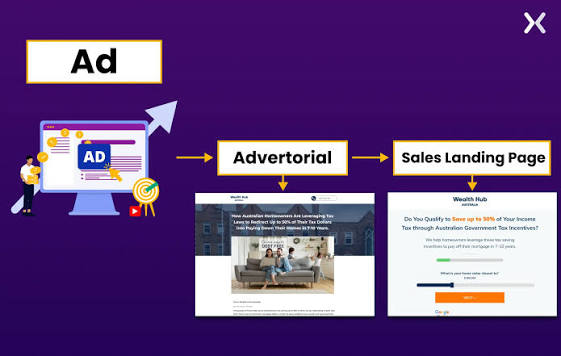
A Simple Funnel: Ad, Advertorial, Landing Page
A multi-step funnel can work when each page answers a different question. It can also add friction, slow the journey, and lose visitors. Do not add an advertorial simply because a native network is involved; give every step a specific job and verify that it improves the outcome.
- Ad: Make a clear, accurate promise about what the visitor will find.
- Advertorial (optional): Deliver the promised information, disclose the commercial purpose where appropriate, and explain the offer’s relevance.
- Landing page: Present the offer, important terms, evidence, limitations, and one clear action.
- Conversion and follow-up: Track completed purchases or qualified leads, not just clicks between pages.
How to Test Whether an Advertorial Helps
Do not assume that a bridge page cuts CPA or improves conversion. Compare it with a relevant alternative using comparable traffic and the same offer. If possible, keep targeting, creative, attribution settings, and the measurement window consistent.
- Track the whole path: ad click → advertorial engagement → offer click → lead or purchase.
- Use business outcomes: compare CPA or ROAS alongside lead quality, refunds, and downstream sales where available.
- Check drop-off: find whether visitors leave before reading, after clicking the CTA, or on the landing page.
- Allow for sample size: small impression or conversion counts are directional; do not treat them as proof.
- Change one major variable at a time: for example, test the destination page while holding the offer and audience steady.
Suppose two test variants each receive 1,000 clicks. Variant A produces 10 purchases and Variant B produces 12. That is a difference in this hypothetical sample, not proof that the second page will always perform better. Compare spend, attribution, lead quality, and uncertainty before choosing a winner.
Mistakes to Avoid
- Treating page type as a universal rule: traffic intent, offer complexity, and the ad promise matter more than labels.
- Using unverified statistics: avoid generic bounce-rate ranges, fixed reading times, and CPA-reduction promises unless you have reliable evidence for the exact context.
- Hiding the commercial purpose: make sponsorship, affiliate relationships, and product promotion clear where required.
- Breaking message match: the destination should fulfill the headline and ad promise.
- Adding unnecessary steps: if a direct landing page answers the visitor’s needs, an advertorial may add friction instead of value.
- Measuring clicks alone: more CTA clicks do not necessarily mean more profitable or higher-quality conversions.
Build an Advertorial Page That Fits Your Funnel
If you need a starting layout, the AdvertorialPages library offers 600+ ready-to-customize templates. If your campaign needs a tailored structure, copy, and design, you can request a custom build. Treat either option as a starting point that still needs product-specific facts, transparent disclosures, and testing.