How to Write an Advertorial That Converts Native Ad Traffic
If your native ad gets the click but the advertorial loses the visitor, the problem usually isn't the traffic. The problem is the bridge between curiosity and conviction. A native ad can create enough interest to earn a click. But that click arrives with very little trust. The reader is cold, distracted, and often unaware of your brand. If the advertorial immediately starts pitching the product, you've skipped the psychological step that made the format useful in the first place.
The better approach is to build a controlled progression:
- The ad creates curiosity.
- The advertorial earns attention.
- The story creates understanding.
- The mechanism creates belief.
- The proof reduces risk.
- The offer gives the reader a reason to act.
That is the difference between writing an advertorial and engineering one. If you need the actual page designed around this funnel rather than simply written, you can also get a custom advertorial landing page built for native-ad traffic.
What Is Advertorial Copywriting?
Advertorial copywriting is the process of using editorial-style storytelling and persuasive copy to move a reader from an information-seeking mindset toward a commercial action. An advertorial is not simply a blog post with a product link at the bottom. A blog primarily answers a question. A sales page primarily sells. An advertorial sits between those two experiences. Its job is to change the reader's understanding of the problem while creating a logical path toward the offer. The Native Advertising Institute describes an advertorial as paid content designed in an editorial style while promoting a product, brand, or service. That distinction matters because the reader's starting point is different from someone who intentionally searched for your product.
Advertorial copy vs. sales copy: A sales page can reasonably say:
"Our product solves X. Here are the features. Buy now."
An advertorial generally needs to earn that commercial transition. It might instead begin with:
"Why are people who already tried X still struggling with Y?"
Then it investigates the problem. The reader discovers a mechanism. The mechanism creates a new way of looking at the problem. Only then does the product become relevant. For a deeper distinction between these formats, see Advertorial vs Sales Page.
Advertorial vs. Pre-Sell Page: Are They the Same? Not necessarily. A pre-sell page is a funnel role; an advertorial is a content format. A pre-sell page prepares a prospect before the main conversion page. An advertorial is one way to perform that job. Other pre-sell formats can include:
- Quizzes
- Reviews
- Comparisons
- Editorial-style stories
- Educational guides
- Case-study pages
The distinction becomes useful when planning campaigns because you should choose the format based on the traffic and conversion problem, not because "advertorial" is fashionable.
How Does an Advertorial Work in a Native Ads Funnel?
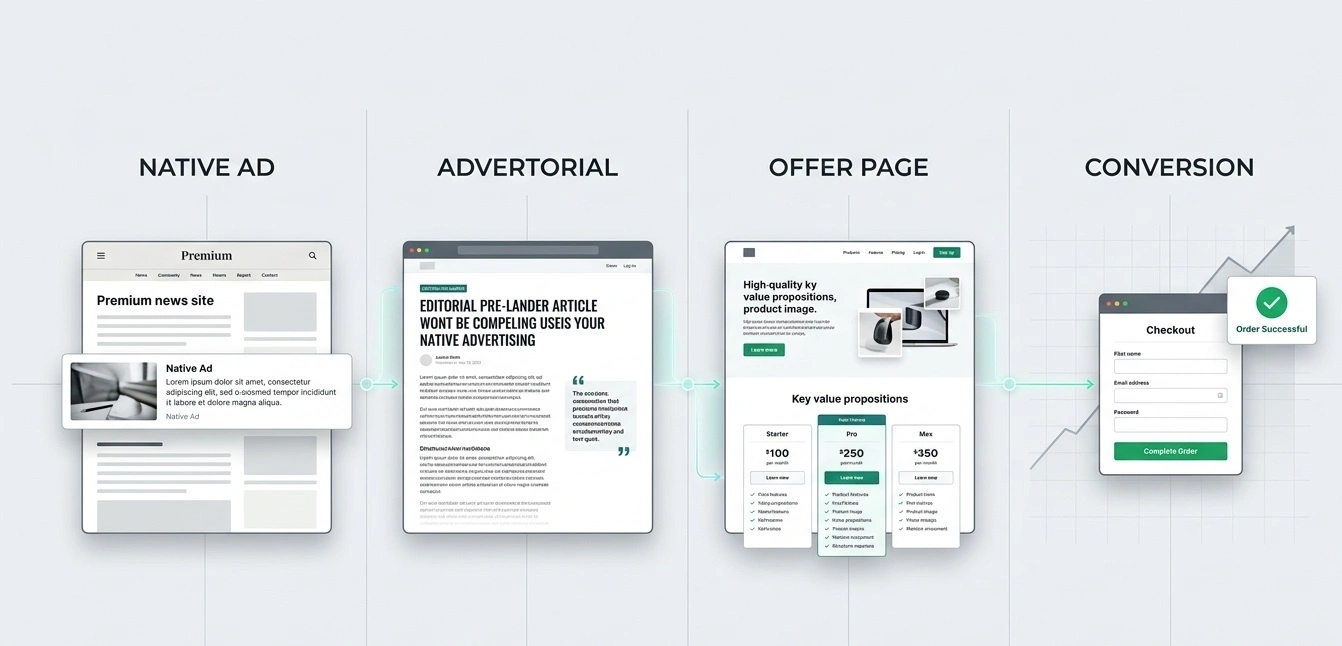
A high-performing advertorial should continue the psychological conversation started by the native ad. The basic sequence is: Native Ad → Advertorial → Offer Page → Conversion. Each stage has a different job.
| Funnel Stage | Reader's Question | Primary Job |
|---|---|---|
| Native ad | "Why should I click?" | Create curiosity |
| Advertorial | "Is this relevant to me?" | Establish relevance |
| Mechanism | "Why is this happening?" | Create understanding |
| Proof | "Can I believe this?" | Reduce skepticism |
| Offer | "Why this solution?" | Establish fit |
| CTA | "What should I do?" | Trigger action |
Outbrain's advertorial guidance similarly positions the advertorial before the offer page, using the content experience to prepare the reader before the commercial step.
The critical principle: don't waste the click. The biggest mistake is treating the native ad and advertorial as two independent assets. Imagine the ad says:
"The simple reason your skin routine isn't working."
The user clicks expecting a diagnosis. Then the advertorial opens with:
"Meet the revolutionary skincare system changing everything."
The funnel has broken. The reader expected a diagnosis; the page gave them sales copy. That mismatch creates friction before the product has earned attention.
Where an Advertorial Fits in the Bigger Funnel: The advertorial is most effective when every stage of the funnel has one coherent argument. A practical funnel looks like: Native Ad ➔ Creates curiosity. Advertorial ➔ Explains the problem and mechanism. Offer Page ➔ Converts intent into action. Thank-You / Post-Conversion ➔ Continues the customer journey. This is why understanding the entire Native Ads Funnel matters. An advertorial can be beautifully written and still fail if the ad attracts the wrong person or the offer does not match the promise.
Stop starting from zero. Get instant access to 600+ ready-to-customize HTML advertorials covering multiple niches, angles, and funnel structures—designed to give you a structured starting point instead of another blank page.
Research Before You Write the First Sentence
The best advertorial copy is usually written after the research, not after the headline. Before writing, build a simple Voice-of-Customer file. Look at: Customer reviews, Product reviews for competitors, Reddit discussions, YouTube comments, Community discussions, Product complaints, Frequently asked questions, Search suggestions, Comments on competitor content, Existing customer support questions.
You are looking for five things:
- Pain: What problem is repeatedly described? Not the marketing version. The customer's version.
- Failed solutions: What have people already tried? This is particularly valuable because failed attempts create a natural opening for a new mechanism.
- Desired outcome: What does the customer actually want? "More energy" is vague. "I don't want to crash at 3 PM" is specific.
- Objections: What stops the person from buying? Common categories include: Price, Trust, Effectiveness, Complexity, Previous disappointment, Risk, Time, Switching costs.
- Language: Copy the ideas, not the wording. If customers repeatedly describe something as "too complicated," don't replace that insight with corporate language such as "streamlined user experience." The customer's language often tells you what the headline should sound like.
How to Choose the Right Advertorial Angle
Your angle determines what the reader believes the article is about before they read the first paragraph. The product is not the angle. The interesting explanation surrounding the product is the angle. Consider these approaches:
- Problem angle: Why Your Morning Routine May Be Making You More Tired.
- Discovery angle: Researchers Found a Different Way to Approach Afternoon Energy.
- Mistake angle: The 3 Common Mistakes People Make When Trying to Improve Sleep.
- Mechanism angle: Why Most Solutions Attack the Symptom Instead of the Cause.
- Comparison angle: What Actually Changes When You Stop Treating X Like Y.
- Story angle: The Unexpected Reason One Small Company Changed Its Approach to X.
The strongest angle usually contains a tension. Something isn't working. The reader doesn't know why. The advertorial promises to explain it. That creates an information gap.
A useful angle test: Before writing, complete this sentence:
"This advertorial is interesting because the reader will discover ______."
If the answer is "our product," the angle is weak. If the answer is "why the solution they have been using may not address the actual problem," you have something to work with.
How to Write an Advertorial Headline and Hook
The headline should sell the reading experience before it sells the product. Your headline has one primary task: Earn the next sentence. For native traffic, avoid headlines that sound like conventional product advertisements. Instead of: "The Best Sleep Supplement for Better Sleep", consider an angle such as: "Why You Can Sleep 8 Hours and Still Wake Up Exhausted". The second headline creates a question. Why does this happen? That question becomes the engine of the advertorial.
A practical headline formula:
- Unexpected problem + curiosity: Why X Doesn't Work the Way Most People Think.
- Problem + overlooked mechanism: The Overlooked Reason X Keeps Happening.
- Audience + discovery: What [Audience] Are Learning About X.
- Failed solution + alternative explanation: Why Trying Harder at X May Not Fix the Real Problem.
Headlines for Native Ads: The strongest advertorial headline usually creates a specific unresolved question rather than announcing a product benefit. Avoid manufacturing urgency that the offer does not support. A headline should create curiosity, not deception.
The hook: The first paragraph should immediately validate the click.
- Don't spend 150 words introducing the company.
- Don't begin with "In today's busy world..."
- Don't explain what an advertorial is.
- Start with the problem.
- Then intensify it.
- Then create the information gap.
A simple structure is: Problem → Consequence → Contradiction → Promise of explanation.
How to Build the Story & Framework
A good advertorial creates forward momentum: every section should answer one question while opening the next. Think of the article as a sequence of belief changes:
- Stage 1: "This is happening to me." — Establish relevance.
- Stage 2: "I didn't realize why." — Introduce the mechanism.
- Stage 3: "That explains my previous failures." — Reframe the problem.
- Stage 4: "There may actually be another approach." — Introduce the solution category.
- Stage 5: "This particular product fits that approach." — Introduce the offer.
- Stage 6: "I understand what I need to do next." — Present the CTA.
This is much stronger than dumping features into the middle of a story.
Use the Problem → Mechanism → Solution Framework: The mechanism is the missing middle layer in many advertorials: it explains why the problem exists and why the proposed solution makes sense. The framework looks like this:
- Problem: What is happening?
- Mechanism: Why is it happening?
- Solution: What can address it?
The mechanism is powerful because it prevents the product from appearing arbitrary. For example:
- Weak: "People struggle with X. Our product solves X."
- Stronger: "People struggle with X because of Y. Most conventional approaches focus on Z, which is why the problem often persists. A different approach is to address Y directly. That's where [product] enters the picture."
Notice what changed. The product is no longer the explanation. The mechanism is the explanation. The product becomes the implementation of that explanation.
How to Introduce the Product Naturally
Don't hide the product artificially; introduce it when the reader understands why the solution category matters. There are two opposite mistakes. Mistake 1: Product too early. "Our revolutionary product..." The reader hasn't earned any reason to care. Mistake 2: Product too late. You spend 2,000 words creating curiosity and then suddenly reveal the product in the final paragraph. That can feel manipulative.
Better approach: Use this progression:
- Problem
- Failed approaches
- New mechanism
- Solution category
- Product
For example: "If the real issue is X, then the solution isn't necessarily to do more of Y. It may be to address Z. That's the principle behind [product]." That transition feels logical because the product is answering a question the article has already created.
How to Add Proof Without Manufacturing Trust
Proof should answer a specific objection; generic praise is weak proof. A testimonial saying: "Amazing product! I love it!" does very little. A useful testimonial addresses a problem: "I'd already tried three alternatives, but the biggest difference for me was..." That gives the reader something concrete.
Useful proof types:
- Demonstrations
- Before/after evidence where legitimate and appropriately substantiated
- Customer testimonials
- Reviews
- Expert commentary
- Product data
- Case studies
- Transparent comparisons
- Screenshots
- Methodology
- Third-party validation
The rule: Never manufacture proof because the page "needs" proof. If you don't have a statistic, don't invent one. If you don't have a study, don't imply you do. If you don't have customer data, use a different form of evidence. Credibility is easier to destroy than to build. Google's current guidance explicitly favors reliable, original, people-first information rather than pages that mainly summarize what others have already said.
How to Write a CTA That Moves the Reader
The best advertorial CTA tells the reader exactly what happens next and reinforces the reason they should click. Avoid generic CTAs when a more specific action is possible. Weak: Learn More. Better: See How the System Works. Weak: Buy Now. Better: See Today's Offer. Weak: Submit. Better: Check My Eligibility. The correct CTA depends on the offer. A strong CTA usually contains an action, a clear destination, a relevant benefit, and objection reduction where appropriate. For example: See How It Works, followed by: No commitment required. Only use the second line if it is actually true.
CTA placement: Don't automatically place a button after every paragraph. Instead, consider the reader's decision points:
- After the mechanism: The reader understands the problem.
- After meaningful proof: The reader has increased confidence.
- After the offer reveal: The reader understands the commercial solution.
The CTA should appear when the reader has a reason to act—not merely because the designer wants another button.
Advertorial Structure Template & Timeline
A practical advertorial structure is a sequence of belief-building stages rather than a fixed word-count formula. How Long Should an Advertorial Be? There is no universal winning word count. The advertorial should be long enough to create the necessary belief and short enough to avoid unnecessary reading. A simple rule: Stop when the reader has enough information to make the intended next decision.
Use this as a starting framework:
- Native-ad promise
- Headline
- Immediate hook
- Problem
- Consequences
- Failed/common approaches
- New insight
- Mechanism
- Solution category
- Brand/product introduction
- Product explanation
- Proof
- Objection handling
- Offer
- CTA
- Final reassurance
The CLICK-BRIDGE framework: For performance campaigns, use this more aggressively:
| Stage | Question | Copy Objective |
|---|---|---|
| Click continuity | "Is this what I expected?" | Match the ad |
| Lead | "Is this about me?" | Establish relevance |
| Insight | "What's really happening?" | Create curiosity |
| Mechanism | "Why does this happen?" | Create belief |
| Credibility | "Can I trust this?" | Reduce skepticism |
| Knowledge | "What should I do?" | Establish solution |
| Bridge | "Why this product?" | Connect offer |
| Risk removal | "What could go wrong?" | Handle objections |
| CTA | "What's next?" | Trigger action |
| Evidence | "Did it work?" | Measure |
| Revision | "Where did people stop?" | Optimize |
Writing Timeline: The writing process should start with the traffic source and end with conversion analysis:
- Ad concept
- Audience research
- Angle
- Headline
- Hook
- Mechanism
- Story
- Product bridge
- Proof
- CTA
- Launch
- Measure
- Revise
Step 1 — Audit the native ad: What promise does the ad make?
Step 2 — Define the one reader: Define the actual prospect.
Step 3 — Choose one angle: One strong angle is easier to understand.
Step 4 — Build the mechanism: Why does the problem exist?
Step 5 — Draft the story: Follow the belief progression.
Step 6 — Add proof: Insert evidence where skepticism appears.
Step 7 — Connect the offer: Make the product the logical next step.
Step 8 — Write the CTA: Tell the reader what happens after the click.
Step 9 — Test the funnel: Don't judge the advertorial independently.
A Practical Advertorial Writing Template
Use this worksheet before drafting. Complete each line with evidence from the offer, audience research, and the ad itself. If you cannot answer a question honestly, research it or leave the claim out rather than filling the gap with a guess.
1. Match the click
Ad promise: What did the person expect to learn after clicking?
[Write the exact promise made by the ad.]
Target reader: Who has this problem, and what have they already tried?
[Describe one specific audience and their current situation.]
2. Find the angle
Problem: What is frustrating the reader?
[State the problem in the reader's own language.]
New insight: What useful explanation or perspective can the article support?
[State the insight. Do not invent a scientific or technical mechanism.]
3. Build the argument
Opening: Confirm the click and name the problem.
[Two or three sentences that make the relevance clear.]
Mechanism: Explain why the problem may happen, using supportable facts.
[Explain the mechanism and cite evidence where a factual claim needs support.]
Solution bridge: What type of solution follows logically from that explanation?
[Introduce the solution category before naming the product, when appropriate.]
4. Earn the next action
Proof: What real evidence answers the reader's biggest objection?
[Insert a genuine demonstration, review, data point, or transparent comparison.]
Product transition: Why is this offer relevant to the argument?
[Connect a real product feature to the reader's need.]
CTA: What exactly happens after the click?
[Use a specific action that accurately describes the destination.]
Final check: Read only the ad, headline, opening, and first transition in sequence. Would the reader recognize the same promise throughout? Then review every factual claim, testimonial, statistic, and implied result. Remove anything you cannot substantiate.
Native Ads Example: A Line-by-Line Breakdown
The fastest way to understand advertorial copywriting is to see how each sentence performs a different job. Consider a fictional product in a non-regulated category: a productivity application. Native ad: Why do some teams finish the day with fewer tasks despite working fewer hours? The ad creates curiosity. It does not say "Buy our productivity app." Advertorial headline: The Productivity Problem May Not Be Your Team's Workload. Now the reader expects an explanation. Opening: Most teams respond to overloaded schedules by adding more tools, more meetings, and more reminders. Yet the underlying problem may be the way work moves between people. Job: Establish the problem. Tension: A task can be technically simple and still consume hours when ownership, context, and approval are scattered across different systems. Job: Deepen the problem. Mechanism: The bottleneck isn't always the amount of work. Sometimes it is the number of handoffs required to complete it. Job: Introduce a new explanation. Solution category: That changes how the problem should be approached. Instead of adding another layer of notifications, teams can reduce the number of handoffs inside the workflow. Job: Present the solution principle. Product bridge: This is the principle behind [Product]: centralize the workflow so each task moves through a defined sequence instead of bouncing between disconnected tools. Job: Introduce the product naturally. Proof: The product documentation shows how the workflow is configured, while customer examples demonstrate how teams use it in practice. Job: Tell the reader where evidence comes from. No invented statistic. No fake "97% improvement." CTA: See How the Workflow Works. Job: Move the reader to the next logical step. That's advertorial copywriting. Not "write 1,000 persuasive words." Engineer the sequence of beliefs.
Common Advertorial Writing Mistakes
Most weak advertorials fail because the copy breaks the reader's expected journey:
- Starting with the brand — The reader clicked because of the problem, not because they were searching for your company.
- Writing like a sales page — Heavy feature lists destroy editorial momentum.
- Using a fake "news" voice — An advertorial can use editorial conventions without pretending to be independent journalism. Transparency matters. The Native Advertising Institute specifically emphasizes clearly identifying paid content and using appropriate sponsored-link practices.
- Overusing hype — Words such as Revolutionary, Amazing, Incredible, Game-changing, Breakthrough do not create credibility by themselves. Specificity does.
- Inventing statistics — Never add a number because a paragraph "needs" authority.
- Explaining features before the mechanism — Features answer "What does it have?" The mechanism answers "Why does this solution make sense?" The second question usually deserves attention first.
- Ignoring the ad — The advertorial should not feel like a completely different campaign.
- Hiding the CTA — A reader should understand the next step without hunting for it.
- Writing one advertorial for every audience — Different angles can attract different prospects.
- Optimizing only for CTR — A cheap click is not necessarily a valuable click. The goal is not simply Ad → Click, but Ad → Qualified attention → Offer interaction → Conversion.
How to Optimize an Advertorial for Conversions
Optimize the weakest stage of the funnel instead of rewriting the entire advertorial blindly. Think in diagnostic terms:
- High ad CTR + poor advertorial engagement: Possible issue: Expectation mismatch. Check: Headline continuity, Opening paragraph, Page load, Mobile layout, Ad-to-page promise.
- Good engagement + low offer clicks: Possible issue: The commercial bridge is weak. Check: Product transition, Mechanism, Offer relevance, CTA placement, Objections.
- Good offer clicks + poor conversion: Possible issue: The problem may be downstream. Check: Offer page, Price, Checkout, Form friction, Trust, Product-market fit.
This is why an advertorial should never be optimized in isolation.
Mobile Optimization Is Part of Advertorial Writing: On mobile, copy structure becomes a conversion variable because large text blocks can hide the narrative and CTA. Use:
- Short paragraphs
- Clear subheads
- Bullets
- Strong visual hierarchy
- Comfortable spacing
- Fast-loading media
- Prominent but natural CTAs
- Scannable proof
Your mobile advertorial optimization guide can be used as the implementation layer after the copy is written. The principle is simple: If the reader cannot comfortably scan the argument, they cannot comfortably follow it.
How to Test an Advertorial: Don't test random wording changes; test hypotheses about why the reader is not moving forward:
- Test 1: Angle: Hypothesis: The current angle is too generic. Test: Problem angle, Mechanism angle, Discovery angle.
- Test 2: Headline: Keep the body relatively stable. Change the reason for reading.
- Test 3: Opening: Test whether a direct problem statement beats a story-led introduction.
- Test 4: Product transition: Test an earlier versus later product introduction.
- Test 5: CTA: Test CTA language based on the actual next step.
- Test 6: Proof placement: Move proof closer to the objection it addresses.
The goal is not to discover a magical sentence. The goal is to identify which belief is preventing progression.
Advertorial Copywriting Checklist
Before publishing, run the page through this checklist:
- Traffic match: Does the headline fulfill the native ad's promise? Does the image/context make sense after the click? Is the audience specific?
- Copy: Is the problem obvious? Is the angle distinct? Is there a mechanism? Does each section move the story forward? Is the product introduced logically?
- Proof: Are claims supportable? Is proof specific? Are testimonials authentic? Are numbers sourced?
- Conversion: Is the offer obvious? Is the CTA specific? Are objections addressed? Is the next step clear?
- Experience: Is the page mobile-friendly? Are paragraphs short? Can the reader scan the page? Does the page load quickly? Are unnecessary distractions removed?
- SEO: Does the page satisfy a real search intent? Does it add information beyond competing pages? Are entities used naturally? Are internal links relevant? Is the content genuinely useful without relying on keyword repetition? Google's current documentation says AI search features still rely on foundational Search practices and people-first content; there are no separate "AI optimization tricks" that replace quality and eligibility for Search.