VSL vs Advertorial: Differences, Costs & How to Choose
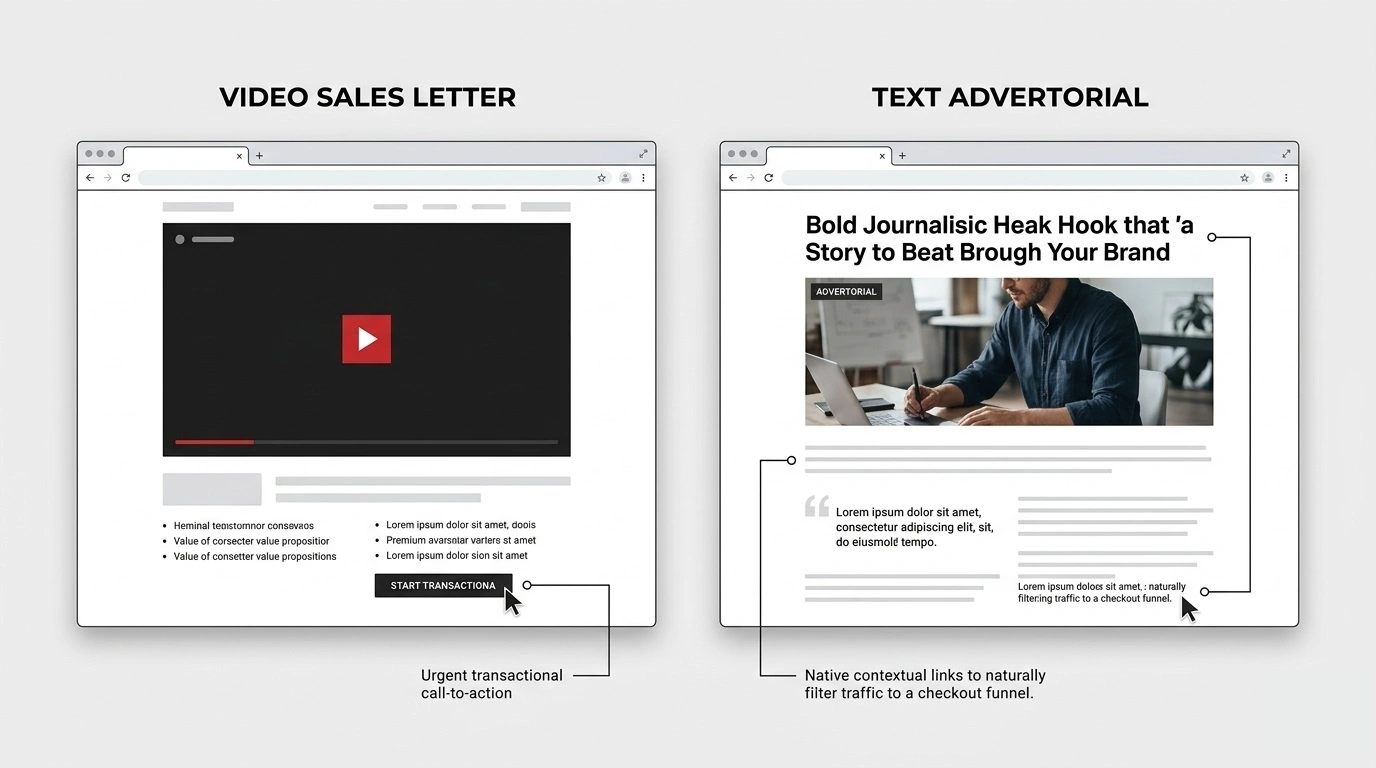
A video sales letter (VSL) and an advertorial are two different ways to present an offer after a person clicks an ad. A VSL delivers much of the sales message through video; an advertorial uses written content to explain a topic and introduce a commercial offer. Neither format wins in every campaign. The right choice depends on the audience, offer complexity, creative-to-page continuity, production resources, and results from a controlled test.
This guide compares the formats for native advertising without assuming that reading-context traffic always prefers text, that video is automatically more persuasive, or that either format guarantees platform approval.
VSL vs. Advertorial: What Is the Difference?
| Factor | Video Sales Letter (VSL) | Advertorial |
|---|---|---|
| Main format | Video carries the core explanation and sales message. | Written content carries the explanation, context, and transition to the offer. |
| Best use case | May suit offers that benefit from demonstration, narration, or a detailed guided explanation. | May suit offers that need context, comparisons, ingredient or feature explanations, or a step-by-step narrative. |
| Production needs | Script, filming or animation, editing, captions, hosting, and video QA. | Research, copywriting, page design, imagery, and responsive implementation. |
| Visitor control | Visitors choose whether to watch and may skip or leave before key information appears. | Visitors can scan headings, read selected sections, and move directly to information they need. |
| Testing changes | Changes to narration, timing, or visuals may require additional editing. | Headlines, sections, images, and calls to action can often be revised independently. |
| Key risks | Autoplay behavior, sound, accessibility, loading, and claims made in the video. | Long or repetitive copy, unclear sponsorship, weak evidence, and a mismatch between the ad and page. |
When a VSL may be the better choice
- The product benefits from demonstration: showing how a product works may communicate more clearly than text alone.
- The offer needs a guided explanation: a video can organize a complex message, provided the viewer can access the essential details without being forced to watch.
- The presenter adds real value: a qualified demonstrator or subject-matter expert can make a complicated process easier to understand when credentials and claims are represented accurately.
- You can support production and testing: video needs captions, mobile checks, playback testing, and a plan for updating claims or creative.
A VSL is not automatically the right choice for high-ticket offers, and a long video is not necessarily more effective than a short one. Match its length to the amount of information the viewer needs and test whether viewers reach the relevant message and CTA.
When an advertorial may be the better choice
- The decision needs context: written content can explain how a product works, compare options, or help readers evaluate features.
- Visitors need to scan: clear headings, summaries, tables, and links help readers find the information relevant to them.
- You need to iterate quickly: copy and layout can often be tested without producing a new video for every variation.
- Evidence matters: written claims can be placed alongside sources, qualifications, and limitations, making them easier to inspect.
An advertorial should not disguise its commercial purpose or imitate independent journalism in a misleading way. Make sponsorship or affiliate relationships clear where required, and keep the transition to the offer honest and consistent with the ad.
What about a hybrid page?
A hybrid page combines useful written content with an optional video. It can be worth testing when some visitors want to read while others prefer a demonstration or narrated explanation. It is not inherently more compliant or more profitable than either format alone.
Start with a clear headline and a concise introduction. Explain the topic in readable sections, offer an optional video with accessible controls and captions, continue with evidence and product details, then present a clear CTA and relevant offer terms.
Do not hide essential conditions or disclosures inside a video that visitors may skip. Avoid forced playback, and verify the network’s current rules for the specific placement and campaign.
Compare costs without relying on universal price ranges
Production costs vary by country, team, complexity, talent, research needs, and revision scope. A simple VSL made from existing footage may cost less than a heavily researched advertorial; a professionally produced video may cost much more than a basic written page. Rather than treating generic online price ranges as fixed benchmarks, estimate the actual work required for each format.
| Cost or effort | VSL considerations | Advertorial considerations |
|---|---|---|
| Initial production | Script, recording, editing, voice, graphics, captions, and hosting. | Research, copy, design, image rights, development, and fact-checking. |
| New variations | May require new recording or edits when the message changes materially. | Often allows smaller copy, headline, section, and layout changes. |
| Maintenance | Update outdated claims, on-screen text, narration, and video assets. | Update copy, links, citations, product terms, and layout. |
| Measurement | Track playback starts, viewing milestones, CTA clicks, and downstream outcomes. | Track engaged reading, scroll depth where useful, CTA clicks, and downstream outcomes. |
Compliance and transparency: evaluate the whole experience
Do not assume that one format is easier to approve across every network. Requirements can differ by platform, placement, market, product, and the actual claims made. Review the current policies for each campaign rather than relying on broad statements that one network is always stricter.
- Keep claims in the ad, page, and video accurate, consistent, and supported.
- Do not fabricate testimonials, personal experiences, endorsements, research, or performance figures.
- Disclose sponsored content and affiliate relationships where required; do not present an advertorial as independent reporting when it is not.
- Make pricing, recurring charges, cancellation, refund, and material offer conditions easy to find.
- Check mobile usability, accessibility, playback controls, page loading, redirects, and checkout functionality.
- Review current platform guidance, including Taboola advertising policies and Outbrain content review guidance.
For broader native-ad landing-page planning, see our native ads funnel guide and advertorial landing page guide.
How to test VSL vs. advertorial fairly
- Choose one business objective. Use a meaningful outcome such as qualified leads, purchases, or contribution margin—not clicks alone.
- Keep the offer and audience comparable. Avoid changing targeting, price, creative, and landing-page format all at once.
- Align the ad with the destination. A creative that promises a demonstration should not lead to a page that provides no demonstration; a content-led ad should deliver the promised information.
- Define primary and diagnostic metrics. Track cost per qualified conversion or purchase, and use page engagement or video milestones to understand why results differ.
- Allow for adequate data. Set a decision rule before the test and avoid declaring a winner from a handful of conversions or a short, unrepresentative period.
- Check quality and risk. Consider refunds, lead quality, user complaints, disclosure clarity, mobile performance, and policy issues—not only the initial conversion rate.
- Iterate one meaningful variable at a time. If one format performs better, investigate whether the difference came from message, presentation, page speed, or another factor before scaling.
Which format fits different offers?
| Situation | Starting hypothesis | What to validate |
|---|---|---|
| Physical product that is easier to show than describe | Test a demonstration-led VSL or a page combining product visuals and text. | Whether viewers understand the product and proceed to a qualified purchase. |
| Product requiring comparison or detailed research | Test an advertorial with clear criteria, evidence, and comparisons. | Whether readers find the content useful and take the next step. |
| Complex service or high-consideration offer | Test both formats; a guided video and a scannable written explanation may serve different users. | Lead quality, downstream conversion, and cost of producing variations. |
| Native traffic from a content recommendation | Start with the format that most clearly fulfills the ad’s promise; do not assume the source alone determines the winner. | Message continuity, engagement, conversion quality, and current platform rules. |
Need help building the page?
If you need a custom advertorial or hybrid landing page, build it around the real offer, audience, evidence, and testing plan. No page design can guarantee a conversion lift or approval on a specific advertising network.
Request a custom advertorial build on Fiverr →
Related reading: advertorial templates, pre-sell pages, and advertorial conversion optimization.