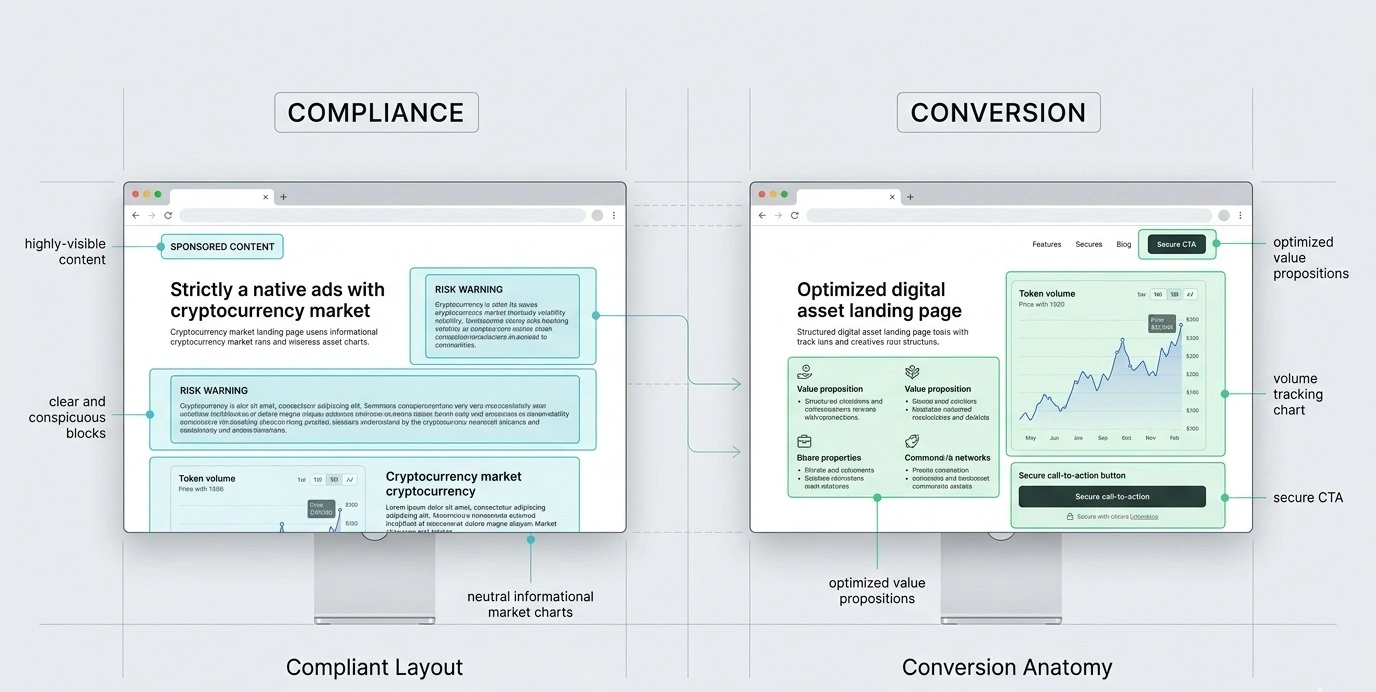
Crypto Native Ads Landing Pages: Strategy & Compliance
Crypto native ads connect campaigns with audiences already reading about blockchain, digital assets, trading tools, and Web3. But the click is only the start. The landing page must explain the offer clearly, match the promise made in the ad, and meet the requirements that apply to the product, audience, market, and advertising network.
This guide focuses on the destination page: how to plan its message, structure the content, present risk information, and review it before launch. It does not promise approval or assume that every crypto product is eligible on every network.
What Is a Crypto Native Ads Landing Page?
A crypto native ads landing page is the page a visitor reaches after clicking a sponsored placement on a news site, publisher feed, or other content environment. The placement may promote a crypto exchange, wallet, blockchain product, educational resource, Web3 service, or another offer—but permitted categories vary by network and location.
Native advertising describes how an ad fits into the surrounding placement. It does not mean disguising a promotion as independent reporting. If the destination is sponsored or promotional, make that relationship clear and follow the disclosure rules that apply to the campaign.
Choose the Network Before You Build the Page
Do not assume that a page accepted by one network will be accepted by another. Before writing copy or commissioning a design, check the current official policies for the exact product and target countries.
| What to check | Questions to answer | Why it matters |
|---|---|---|
| Product eligibility | Does the network allow this product category in the target market? | A polished page cannot make an ineligible offer eligible. |
| Geographic restrictions | Which countries can be targeted, and are there local licensing conditions? | Rules may vary by product and jurisdiction. |
| Disclosure and claims | What must be disclosed, and what claims or visuals are restricted? | Copy, evidence, and disclosures should be reviewed together. |
| Technical requirements | Are tracking, destination, privacy, or page-functionality requirements specified? | Broken journeys and missing information can undermine a campaign. |
| Review process | What reason codes or documentation are provided if the campaign is rejected? | Use actual feedback to guide revisions instead of guessing. |
For example, Cointraffic publishes information about its crypto advertising products and campaign process. Treat any platform comparison as a starting point, then verify current eligibility and requirements directly with the network.
Build the Page Around the Offer
There is no single layout suitable for every crypto campaign. A wallet, an exchange, a blockchain analytics product, and an educational guide ask visitors to make different decisions. Choose the page structure that explains the actual offer rather than forcing every campaign into an investment advertorial.
1. Make the headline match the ad
Continue the topic or question that earned the click. Avoid switching to an unrelated promise after the visitor arrives. The headline should describe what the page genuinely explains or offers.
2. Explain the product and its limitations
State what the service does, who operates it, what the visitor can do next, and any material eligibility limits. Avoid vague claims such as “the safest platform” or “the easiest way to profit” unless they are accurate, specific, substantiated, and permitted in the relevant context.
3. Support claims with evidence
Do not imply guaranteed returns, risk-free trading, or typical earnings without appropriate evidence and authorization. Screenshots, charts, testimonials, and creator endorsements can also mislead if they imply results users should not expect. Remove or qualify any claim that cannot be substantiated.
4. Make sponsorship and risk information clear
Identify promotional content clearly. Provide risk disclosures and legal information that actually apply to the product and audience. A CFD risk statement, for example, should not be copied into a general crypto-wallet page if it does not describe the offer. Do not invent licensing status, registration details, or a regulator's endorsement.
5. Use a specific, honest call to action
Tell visitors what happens when they click: view product features, read documentation, request a demonstration, or continue to registration. Do not frame an ordinary sign-up as a guaranteed path to profits or hide important conditions until after the click.
A Practical Page Structure
1. Ad promise
Accurate, specific hook
2. Explanation
Offer and audience fit
3. Trust details
Evidence, disclosures, limits
4. Next step
Clear, accurate CTA
This sequence is a planning framework, not a mandatory platform template. Adapt the layout to visitor intent, product complexity, and applicable rules.
Compliance Checks Before Launch
Use this checklist to find preventable issues. It is not a substitute for legal advice or the network's current review requirements.
- Eligibility: confirm the product and target market are allowed by the selected network.
- Ad-to-page consistency: the headline, image, offer, and CTA must not contradict the ad.
- Claims: verify performance, security, licensing, and comparative statements; remove unsupported promises.
- Risk disclosures: use language appropriate to the actual product and jurisdiction.
- Commercial transparency: identify sponsored content and do not impersonate an independent publisher.
- Company details: provide accurate operator and contact information where required.
- Functionality: test every button, form, redirect, privacy link, and tracking event on desktop and mobile.
- Measurement: confirm analytics records intended events without collecting data improperly.
What to Do If a Crypto Campaign Is Rejected
- Read the network's rejection reason and identify the exact page element involved.
- Check whether the problem concerns product eligibility, targeting, claims, disclosures, creative, or technical functionality.
- Review the relevant official policy and the rules for the target market.
- Correct the underlying issue across the ad and destination page—not just the wording flagged in isolation.
- Retest the full visitor journey, then resubmit with a concise explanation if the review process allows it.
Do not assume that adding a disclaimer will fix an ineligible offer, and do not repeatedly resubmit unchanged pages. Approval depends on the campaign and network; no template can guarantee it.
Measure Performance Without Guessing
Once the campaign is eligible and running, evaluate the whole journey rather than clicks alone. Depending on the objective, useful measures may include qualified visits, form completion, registration quality, cost per qualified lead, and downstream outcomes. Compare variants with a defined test plan and enough data to interpret the result. Do not present an early fluctuation as a proven conversion lift.
Frequently Asked Questions
Related Resources
- Learn the core structure in our advertorial landing page guide.
- Review the practical process in our native ads landing page blueprint.
- Learn to write a clear promotional article in our advertorial copywriting guide.
- Improve page testing with our advertorial conversion optimization guide.
- For publisher-specific review issues, see our Outbrain landing page guidelines and Taboola rejection troubleshooting guide.