How to Advertise Supplements on Taboola: Policy & Landing Page Guide
Supplement advertising on Taboola requires more than a persuasive headline. The ad creative, landing page, product claims, evidence, and destination experience all need to tell a consistent and truthful story. Review decisions depend on the current platform rules and the specific campaign; no page structure can guarantee approval.
This guide is a practical checklist for advertisers and affiliates promoting supplements. It separates three things that are often confused: Taboola’s review policies, legal requirements that depend on the market and product, and conversion best practices that should be tested rather than treated as rules.
Start with the product and target market
Before writing an ad, identify the exact product category, ingredients, intended audience, countries targeted, and claims made on the product label. A dietary supplement, a product marketed for weight management, and a product making disease-treatment claims can raise different policy and regulatory questions.
- Verify the product: confirm what it contains, how it is described, and whether the seller can substantiate its claims.
- Define the market: check the rules that apply in each country where the campaign will run. Requirements are not identical worldwide.
- Review the full journey: evaluate the ad headline, thumbnail, advertorial, product page, checkout, and any claims repeated across them.
- Check current platform policy: use Taboola’s official advertising policies and confirm the current rule relevant to the product before launch.
Educational wording does not automatically make a supplement campaign acceptable. A headline, image, testimonial, or implied message can still communicate a product claim even if the landing page avoids direct medical language.
Claims and creative choices to review carefully
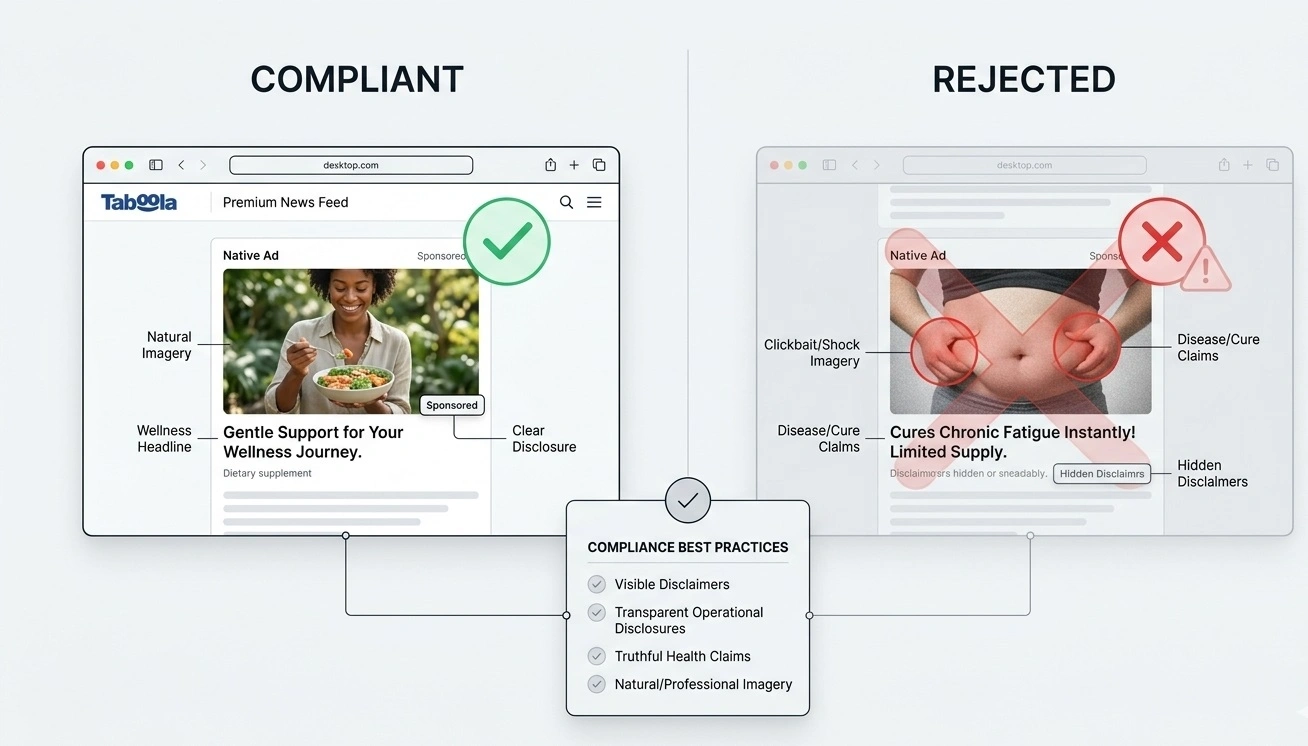
Health-related marketing deserves particular scrutiny because consumers may interpret a claim as a promise about their health. Avoid unsupported, exaggerated, or misleading representations, and do not imply that a supplement diagnoses, treats, cures, or prevents a disease unless the claim is lawful for the product and supported by appropriate evidence. Platform rules may be more restrictive than the law.
| Risk area | Review question | Safer editorial practice |
|---|---|---|
| Disease or treatment claims | Does the wording imply that the product treats, cures, prevents, or reverses a condition? | Remove unsupported medical promises. Describe ingredients and evidence accurately, with context and limitations. |
| Results and transformations | Does the image or copy imply rapid, dramatic, or typical results without adequate support? | Use representative imagery and avoid presenting exceptional outcomes as expected results. Check the platform’s current image rules. |
| Testimonials | Is the reviewer real, was the experience genuine, and does the story imply a claim the advertiser could not make directly? | Use authentic, authorized testimonials and disclose material connections where required. Do not invent first-person experiences. |
| Scientific references | Does the cited research actually study this ingredient, dose, population, and outcome? | Link to the source, describe what it does and does not show, and avoid implying that ingredient research proves the finished product works. |
| Endorsements and urgency | Could the creative imply a false endorsement or create a misleading impression of scarcity? | Use endorsements only with permission and substantiation. Make availability and offer terms accurate. |
For general guidance on sponsored-content transparency and endorsements, consult the FTC’s native advertising guidance and the rules applicable to your target market. These resources are not a substitute for checking local law or Taboola’s current policy.
Build a transparent supplement landing page
An advertorial can explain a product before the reader reaches the offer, but it should not disguise a commercial relationship or imitate independent reporting in a way that misleads visitors. Make the publisher, advertiser, and sponsored nature of the content clear where appropriate, and keep the transition from article to product consistent with what the ad promised.
- Use a specific, accurate headline. Set an expectation the page can genuinely fulfill; avoid sensational health promises.
- Explain the topic before the offer. Provide useful context about the ingredient, product category, or selection criteria instead of padding the page with vague claims.
- Substantiate every product claim. Keep evidence close to the claim and state meaningful limitations. Do not treat a study about one ingredient as proof of a finished formula.
- Identify the commercial relationship. Clearly disclose sponsored content, affiliate links, or other material connections when required, and do not create a false impression of independent endorsement.
- Make the offer understandable. Show the product, price, recurring-payment terms if any, shipping conditions, refund terms, and seller identity accurately.
- Make the page work on mobile. Check readable text, visible links, functional buttons, loading behavior, forms, and the complete checkout path on real devices.
- Provide appropriate business and privacy information. Publish policies and disclosures required for the business, product, data collection, and target market. Do not assume one generic disclaimer satisfies every jurisdiction.
Do you need a medical disclaimer?
There is no single disclaimer that automatically makes every supplement advertisement compliant. The appropriate wording depends on the product, claims, jurisdiction, and applicable platform requirements. In the United States, for example, certain structure/function claims for dietary supplements have specific FDA disclaimer rules; those rules should not be presented as a universal requirement for every product or country.
Use accurate, legally reviewed language where needed, but do not rely on a disclaimer to repair a misleading headline or an unsupported claim. Review the relevant requirements with qualified counsel or a regulatory specialist when the product or claims create material risk.
Should you use an advertorial or link directly to the product?
Neither format is universally approved or universally best. The choice depends on the offer, the user’s expectations, the quality of the product page, and the network’s current rules.
- An advertorial may help when the reader needs context to understand ingredients, compare options, or evaluate a product. It should add real information, not hide the sales purpose.
- A direct product page may fit when the ad and product page are closely aligned and the destination provides the necessary information clearly. Confirm that the format is permitted for the specific campaign.
- Either format can fail if the claims are misleading, the creative does not match the destination, the page is broken, or required disclosures are missing.
For broader funnel planning, see our native ads funnel guide. For page structure, consult the advertorial landing page framework.
Example: an honest educational angle
Instead of inventing a personal story such as “I tested seven supplements and discovered the one doctors hide,” use a verifiable angle that does not imply an experience that never happened. For example:
“How to Compare Supplement Labels: Ingredients, Serving Sizes, and Questions to Ask”
This framing promises an explanation of label-reading criteria, not a health outcome. If the article later discusses a specific product, clearly identify the commercial relationship and substantiate its claims.
This is an editorial starting point, not a guarantee of approval. Review the final headline, image, page copy, product claims, and destination against the current policies before submitting.
What to do when Taboola rejects a supplement campaign
- Read the actual rejection reason. Do not assume every rejection is caused by a medical claim; it may relate to the creative, destination, business model, disclosure, or a technical issue.
- Inspect the entire path. Check the ad and thumbnail, every page in the redirect chain, the product page, checkout, and mobile behavior.
- Locate the exact problem. Identify the claim, image, missing information, broken link, or inconsistency that may have triggered review.
- Correct the underlying issue. Do not simply replace a prohibited phrase with a euphemism while keeping the same misleading implication.
- Recheck all assets. Ensure the revised creative and landing page make consistent, supportable representations.
- Ask for clarification when necessary. If the rejection reason is unclear, use Taboola’s official support or review process instead of guessing.
Our Taboola landing page rejection troubleshooting guide covers the broader diagnostic process. A revision can address a likely issue, but it cannot guarantee approval.
Pre-launch checklist
- Product and seller details are accurate and verifiable.
- Every express and implied health claim is substantiated and lawful in the target market.
- Images, testimonials, endorsements, and research references are genuine and not misleading.
- The ad, advertorial, product page, and checkout tell a consistent story.
- Sponsored content and affiliate relationships are disclosed where required.
- Price, billing, shipping, refund, and subscription terms are clear.
- Required privacy, contact, and legal information is available for the business and market.
- All links, forms, redirects, and checkout steps work on mobile and desktop.
- The campaign has been checked against Taboola’s current policies—not an old checklist or a template’s claims.
Need a custom advertorial?
If you need help structuring an advertorial, the page should be built around the real product, evidence, target market, and current platform rules—not a promise of guaranteed approval or performance.
Request a custom advertorial build on Fiverr →
You can also explore our advertorial template guide, advertorial copywriting guide, and advertorial CRO guide.