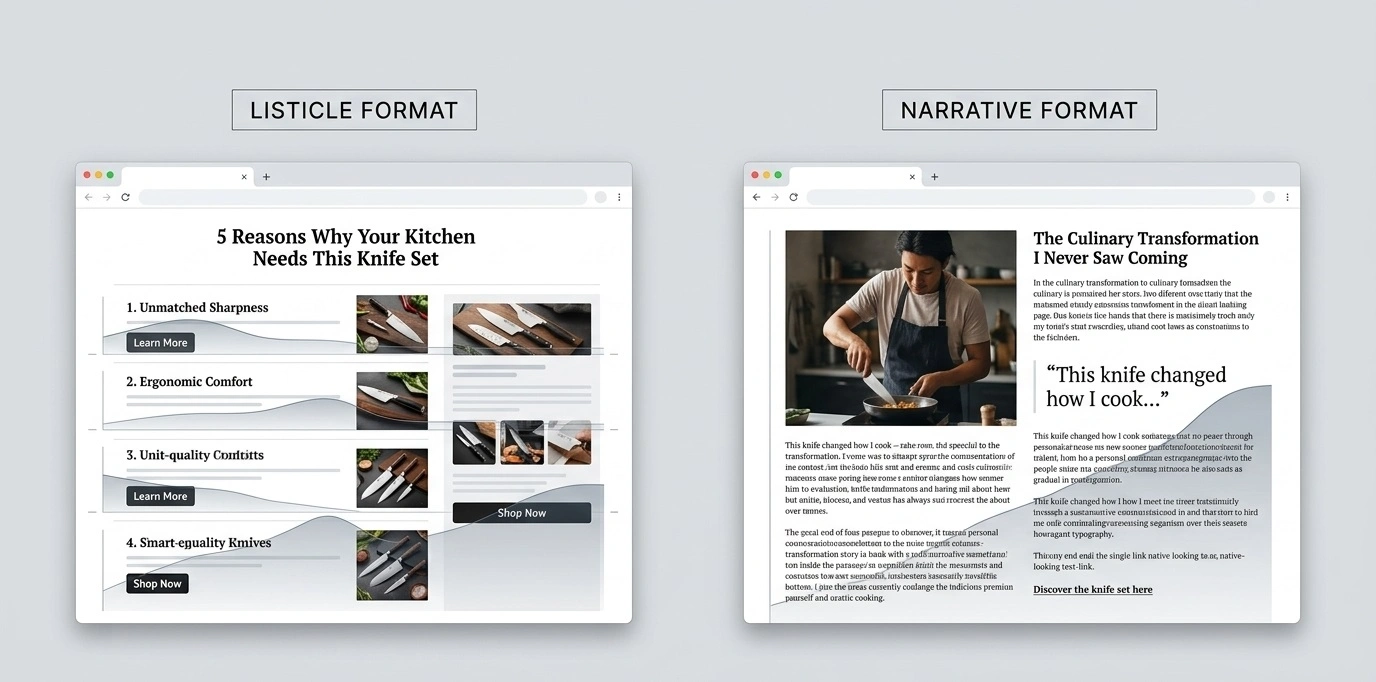
Listicle vs Advertorial: Which Pre-Sell Format Should You Use?
A listicle and an advertorial can both prepare readers for an offer before they reach a product or sales page. The main difference is how they organize the argument: a listicle breaks information into distinct points, while an advertorial develops a connected editorial-style narrative. Neither format wins every campaign.
Listicle vs Advertorial: The Main Differences
The formats are not strict opposites. A page can use an advertorial approach and still include a numbered list. For this comparison, “listicle” means a page organized primarily around separate numbered entries; “advertorial” means a page built around one continuous editorial-style argument that promotes an offer.
| Factor | Listicle | Advertorial |
|---|---|---|
| Structure | Numbered entries, reasons, products, or tips | A connected narrative or explanation |
| Reading pattern | Easy to scan and enter at different points | Usually read in a more linear sequence |
| Core strength | Organizes several distinct points or options | Builds one argument across multiple steps |
| Best-fit task | Compare alternatives or summarize separate benefits | Explain a problem, mechanism, product, or decision in context |
| CTA placement | May appear beside relevant entries and/or at the end | Often follows the main argument, with earlier links where useful |
| Potential drawback | Can feel repetitive or shallow if entries add little value | Can feel long or unconvincing if the story delays useful information |
| Key evaluation | Do readers find a relevant option and take the next step? | Does the explanation help readers understand the offer and take the next step? |
What Is a Listicle Landing Page?
A listicle landing page, sometimes called a listicle lander, organizes its main content as a numbered list. The entries might be products, features, common mistakes, use cases, or reasons to consider a solution. The format gives readers visible sections to scan and compare.
Example structure
Illustrative headline: “5 Features to Compare Before Choosing a Smart-Home Camera”
- Briefly explain the selection criteria.
- Describe the first feature and why it matters.
- Compare relevant options using accurate, verifiable information.
- Explain trade-offs instead of presenting every option as perfect.
- Summarize how to choose and provide a clear next step.
This is a structural example, not a claim about a real campaign or product result.
When a listicle may fit
- The reader needs to compare multiple products, features, or approaches.
- Each point can provide useful information without relying on the previous point for its meaning.
- The offer benefits from a clear selection process, checklist, or ranked set of options.
- Readers are likely to scan for the point most relevant to their needs.
A listicle is not automatically short, neutral, or easier to approve. Its quality depends on the accuracy of the claims, the fairness of the comparisons, the clarity of the commercial purpose, and the page experience.
What Is an Advertorial?
An advertorial combines editorial-style information with a commercial purpose. A pre-sell advertorial usually helps readers understand a problem, evaluate an explanation, or consider a product before sending them to the offer. Its structure can be a narrative, an educational article, a product demonstration, or another connected argument.
Example structure
Illustrative headline: “What to Check Before Choosing a Home-Water Filter”
- Introduce the decision the reader is trying to make.
- Explain the relevant factors and common misunderstandings.
- Show how different solutions address those factors, including limitations.
- Explain where the featured offer fits and who it may not suit.
- Provide a transparent next step to learn more.
The example does not imply personal testing, endorsements, or results.
When an advertorial may fit
- The offer requires explanation before a reader can evaluate it fairly.
- The buying decision depends on context, trade-offs, or a sequence of ideas.
- A single central argument is more useful than a collection of independent entries.
- The page can support its claims with reliable evidence rather than invented stories or testimonials.
An advertorial does not need to disguise advertising as independent journalism. Its commercial nature should be clear to readers, and any testimonials, personal experiences, or performance claims should be genuine and properly substantiated.
Audience Awareness: A Useful Clue, Not a Universal Rule
Audience awareness can help guide the choice, but it should not be treated as a rigid formula. A reader may know the problem but not understand the available solutions; another may be comparing specific products yet still need an explanation of important differences.
- Problem-aware readers: An advertorial may help when the page needs to explain context or why a particular approach is relevant.
- Solution-aware readers: A listicle may help when readers want to compare options, features, or trade-offs.
- Product-aware readers: A concise comparison or direct product page may be more appropriate than either format if little pre-selling is needed.
- Mixed-awareness audiences: Use the ad message and early page engagement to decide what information should appear first.
These are planning heuristics, not evidence that one format will outperform another for a given awareness level. Validate the choice with campaign data.
Which Format Fits Different Campaigns?
| Campaign situation | Format to consider first | Reason |
|---|---|---|
| Several comparable products | Listicle | Separate entries can make differences easier to scan. |
| One complex product or new category | Advertorial | A connected explanation can establish context before the offer. |
| Multiple use cases or buying criteria | Listicle or hybrid | Use distinct sections if each point stands alone; add narrative context only if it helps. |
| A product whose value depends on a specific mechanism | Advertorial or educational page | Readers may need the mechanism explained before assessing the product. |
| A familiar, low-consideration product | Test a listicle against a direct product page | Additional pre-selling may not be necessary. |
| A regulated or sensitive category | Either, subject to content and policy review | Format alone does not make claims, testimonials, or targeting compliant. |
Do not assume that all e-commerce offers need listicles or that health and finance offers need advertorials. Product complexity, audience intent, evidence, price, the ad promise, and the destination experience can matter more than the niche label.
Can You Combine a Listicle and an Advertorial?
Yes. A hybrid page might open with a short explanation, present a list of options or decision factors, and finish with guidance on choosing the next step. This can work when the narrative provides context and the list makes the details easier to compare.
But combining formats is not automatically better. Avoid adding a story that does not help the decision or a list whose entries repeat the same claim. Each section should answer a real reader question and move the page toward a clear, honest next step.
Native Ads Compliance: Format Is Not a Shortcut
A listicle is not inherently easier to approve than an advertorial, and an advertorial is not inherently disallowed. Review depends on the applicable network policies and the actual ad, landing page, offer, claims, disclosures, and user experience.
- Make the relationship between editorial-style content and the commercial offer clear.
- Ensure the ad headline and landing page represent the same offer accurately.
- Substantiate product, health, financial, comparative, and performance claims.
- Do not invent reviews, endorsements, test results, or personal experiences.
- Check the current requirements of the specific ad network and the laws relevant to the audience and product.
- Make the page functional, readable on mobile, and clear about what happens after a click.
For general guidance on identifying native advertising, see the FTC’s Native Advertising Guide for Businesses. It is a reference for US guidance, not a substitute for checking other applicable laws or each network’s current rules.
How to Test Listicle vs Advertorial Fairly
When both formats seem plausible, test them instead of choosing based on a universal benchmark. Keep the offer, traffic source, audience, budget conditions, and measurement window as comparable as possible.
- Write one clear hypothesis for each version. For example, a listicle may help readers compare options, while an advertorial may help them understand a complex offer.
- Keep the promise consistent. The ad should set an expectation that the landing page actually fulfils.
- Track the full path. Measure landing-page engagement, click-out rate, downstream conversion rate, CPA, and revenue or profit per visitor where reliable data is available.
- Separate click volume from business outcomes. More clicks to the offer do not necessarily mean more purchases or better economics.
- Allow for uncertainty. Do not declare a winner from a handful of conversions or a short, uneven test.
- Change one major variable at a time. If you change the format, headline, offer, and audience together, it becomes harder to understand what caused the result.
There is no universal click-out rate, ideal word count, approval rate, or production time that applies to every listicle and advertorial. Establish a baseline for your own campaign and use the same definitions when comparing variants.
Quick Decision Checklist
- Choose a listicle as a starting point if readers need to compare distinct options or scan separate points.
- Choose an advertorial as a starting point if readers need a connected explanation before evaluating one offer.
- Consider a hybrid when both context and comparison materially help the decision.
- Consider a direct product page when the audience already has enough information to act.
- In every case, prioritize accuracy, transparent commercial disclosure, mobile usability, and a clear next step.
Frequently Asked Questions
The Bottom Line
A listicle helps readers scan distinct points; an advertorial helps readers follow a connected argument. Use the format that best supports the decision your audience needs to make—not a blanket rule about a particular niche or ad network.
If both structures could work, run a controlled test and evaluate what happens beyond the first click. The goal is not simply to send more visitors to an offer; it is to help the right visitors make an informed next-step decision.
Related Resources: