Nutra Advertorial Examples: 5 Formats & Compliance Tips
Nutra advertorials sit at the intersection of product education, persuasive writing, and health-related advertising. A useful page explains the offer and its evidence without presenting a supplement as a miracle cure, disguising advertising as independent reporting, or promising outcomes that the advertiser cannot substantiate.
The five formats below are illustrative page patterns, not claims about verified campaigns or guaranteed performers. Adapt them to the product, the evidence available, the target market, and the current rules of the ad platform and applicable law. Review the live policies before launch; requirements can differ by product and jurisdiction.
What makes a Nutra advertorial useful?
A strong Nutra advertorial helps readers understand what the product is, what is known about its ingredients, what limitations apply, and what action they can take next. Its headline, body, imagery, and destination offer should tell a consistent story.
- Evidence: distinguish published research about an ingredient from evidence about the finished product.
- Transparency: make the commercial relationship clear instead of implying that a paid page is independent journalism.
- Specificity: explain the product, intended use, ingredients, directions, and relevant limitations without overstating benefits.
- Consistency: make sure the ad promise is supported by the landing page and the offer.
- Usability: provide readable mobile content, working links, accessible contact details, and clear next steps.
5 Nutra advertorial examples and when to use each format
Use these examples as starting structures. Replace bracketed details with verified product information, and remove any claim that cannot be supported for the specific product.
1. The ingredient explainer
Best for: a product whose audience needs a clear explanation of its ingredients before evaluating the offer.
Example headline: “What to Know About [Ingredient]: Uses, Evidence, and Limitations.”
Structure: introduce the reader’s question; explain the ingredient in plain language; summarize relevant evidence with links to reliable sources; explain what the evidence does and does not establish; then introduce the product’s ingredient list and directions.
Watch out for: treating a study on an ingredient as proof that the finished supplement produces the same result. Do not imply that a mechanism or early-stage study proves a clinical benefit.
2. The problem-and-options guide
Best for: readers comparing approaches to a general wellness concern.
Example headline: “A Practical Guide to Comparing [Category] Products.”
Structure: define the decision the reader faces; explain common product differences; give neutral comparison criteria such as ingredients, serving size, cost per serving, and transparent labeling; describe where the featured product fits; and link to full product details.
Watch out for: fear-based copy, shaming readers, suggesting that ordinary symptoms prove a disease, or claiming that competitors are unsafe without reliable evidence.
3. The evidence-led research summary
Best for: audiences who want to understand the research behind an ingredient or formulation.
Example headline: “What Current Research Says About [Ingredient].”
Structure: state the research question; cite the study and its date; explain the population, study design, and limitations; separate findings from interpretation; then explain whether and how the findings relate to the advertised product.
Watch out for: invented experts, vague references to “clinical proof,” cherry-picked results, or scientific imagery that implies endorsement by a university, hospital, or researcher who has not endorsed the product.
4. The transparent product walkthrough
Best for: readers who already understand the category and want to evaluate a specific offer.
Example headline: “Inside [Product]: Ingredients, Directions, Price, and FAQs.”
Structure: identify the product and seller; show the actual packaging; list ingredients and serving directions accurately; explain price, recurring-billing terms, shipping, returns, and customer support; and answer common questions before the CTA.
Watch out for: hidden subscription terms, fake scarcity, unsupported “doctor recommended” language, fabricated reviews, or product images that do not match what customers receive.
5. The personal-story format—with clear disclosure
Best for: a genuine, documented customer experience that can be shared with permission and in a way that does not imply typical or guaranteed results.
Example headline: “One Customer’s Experience With [Product]: What They Can—and Can’t—Tell You.”
Structure: disclose the relationship to the seller; identify the account as an individual experience; avoid presenting the experience as scientific proof; include important context and limitations; and direct readers to objective product information.
Watch out for: fabricated testimonials, scripted stories presented as real, unrepresentative results presented as typical, or personal anecdotes used to make disease-treatment claims.
How to choose the right format
| Format | Reader’s main question | Useful proof | Primary risk to avoid |
|---|---|---|---|
| Ingredient explainer | What is this ingredient? | Reliable research and accurate labeling | Overstating what studies prove |
| Problem-and-options guide | How do I compare options? | Clear, consistent comparison criteria | Fear tactics or unsupported competitor claims |
| Research summary | What does the evidence say? | Traceable studies and stated limitations | Cherry-picking or implying endorsement |
| Product walkthrough | What am I buying? | Actual product, ingredients, price, and terms | Hidden terms or misleading product presentation |
| Personal story | What was one person’s experience? | Authentic, permissioned and contextualized account | Implying typical or guaranteed results |
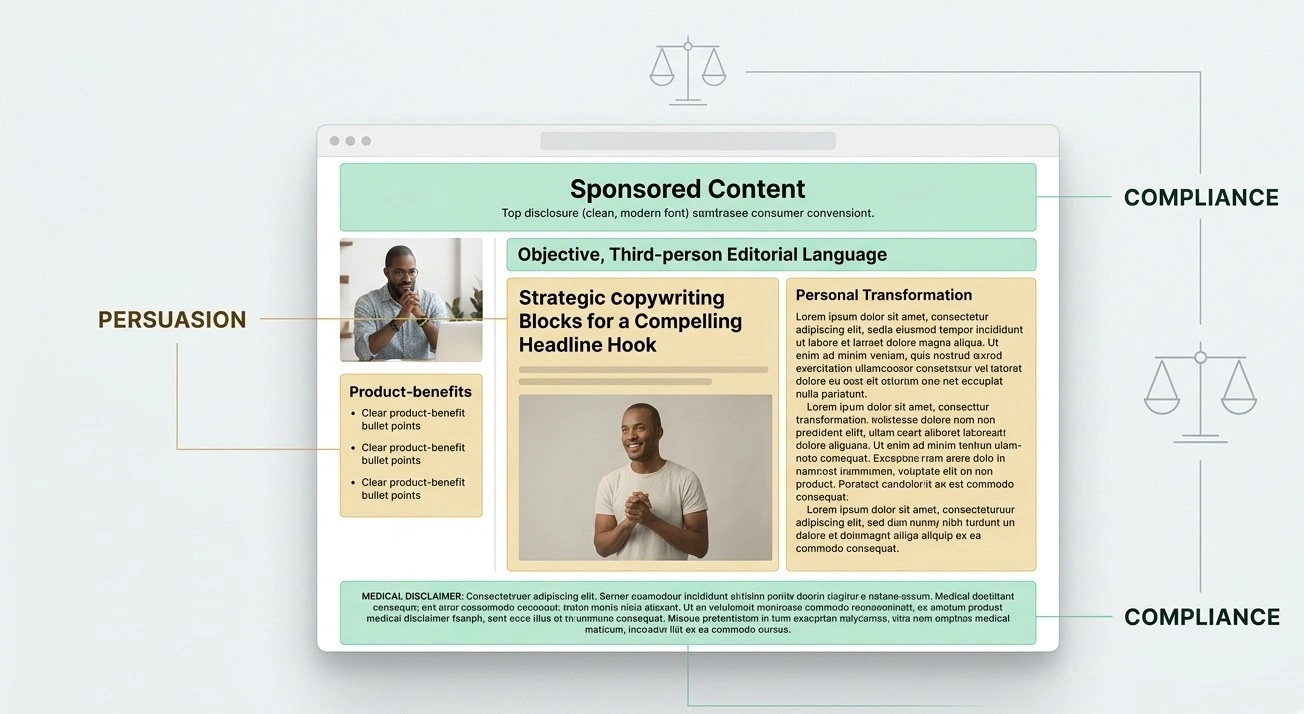
A practical Nutra advertorial page structure
- Clear label and headline: identify the content as advertising or sponsored content where appropriate, and use a headline that accurately describes the page.
- Opening context: state the question the page will answer without inventing a crisis or promising a dramatic outcome.
- Useful explanation: provide the reader with real information before introducing the offer.
- Evidence and limitations: cite relevant sources, describe their limits, and avoid claims broader than the evidence supports.
- Product details: show accurate ingredients, directions, price and purchase terms.
- Clear CTA: explain what happens after the click, including any purchase or subscription commitment.
- Trust and support: provide relevant seller identity, contact, privacy, returns and other required information.
Do not copy a publisher’s branding or make the page look like independent coverage when it is actually a paid promotion. The goal is a readable, editorially structured advertisement—not a misleading imitation of a news outlet.
Nutra advertorial compliance checklist
There is no single disclaimer or layout that guarantees approval across all products, platforms, and countries. Use this checklist as a review prompt, then confirm the applicable requirements for your campaign.
- Every express and implied product claim has suitable evidence for the specific product and market.
- Research is represented accurately, with limitations and sources where relevant.
- No unsupported disease-treatment, prevention, or cure claims are made.
- Testimonials and endorsements are authentic, permissioned, and not presented misleadingly.
- Any material commercial relationship is disclosed clearly.
- Product images, ingredient details, price, shipping, returns, and billing terms are accurate.
- Required legal notices and disclosures are determined for the relevant jurisdiction and product—not copied from a generic template.
- The page works on mobile, loads its main content reliably, and has functioning navigation and purchase links.
- The ad, advertorial, and checkout make consistent claims and describe the same offer.
- The live platform policy and applicable regulatory guidance have been checked before submission.
Improve the page before increasing spend
Review one change at a time. Track ad approval status, landing-page engagement, checkout progression, refunds, and customer complaints alongside conversion metrics. A high click-through rate is not proof that a page is accurate or that customers understand the offer.
When a campaign is rejected, use the platform’s stated reason to diagnose the issue, revise the relevant content, and resubmit for review. Do not assume that a template, disclaimer, or previous approval guarantees future acceptance.
Frequently asked questions
A Nutra advertorial is promotional content for a nutrition, supplement, skincare, or related wellness offer, presented in an informational format. Its commercial nature should be clear, and its product claims should be accurate and substantiated.
It depends on the reader’s question and the evidence available. Ingredient explainers help educate, comparison guides help evaluate options, research summaries explain evidence, product walkthroughs clarify the offer, and genuine stories can add context without proving typical results.
Only claims that are permitted for the product and market and supported by suitable evidence should be used. Disease-related and other health claims can be subject to specific regulatory requirements; review the relevant official guidance rather than relying on a generic template.
Not necessarily. Disclaimer requirements depend on the product, claims, market, and applicable rules. A disclaimer does not make an otherwise misleading or unsupported claim acceptable, so determine the actual requirements for the offer and jurisdiction.
Rules vary by platform, product category, market, and current policy. Check the live policy for the campaign before using them, and avoid imagery that misleads viewers or implies unsubstantiated outcomes.
There is no universal ideal word count. Include enough information to answer the reader’s question, explain relevant evidence and limitations, disclose material terms, and help the reader make an informed decision—without padding the page.
The bottom line
The strongest Nutra advertorial is not the one with the most dramatic promise. It is the one that answers a real reader question, explains the product honestly, supports its claims, and makes the commercial next step clear. Choose the format that fits the evidence and audience, then review the page against the current requirements before publishing.